Unusual silvering on one experimental romaine lettuce line in Castroville led UC Cooperative Extension advisors to suspect heat injury rather than insect feeding or a virus. Their investigation highlights two considerations for growers: matching varieties to the planting season and supplying enough water for cooling without oversaturating the root zone.
The field visit occurred in late August, when a pest control advisor requested help with lettuce approaching harvest. UC published the account Nov. 17. Several romaine varieties were growing in strips, but visible damage appeared only in one numbered, noncommercial line. The neighboring varieties did not show the same injury.
The affected areas were near the tips of outer leaves, where they could be seen without pulling heads apart. Tissue between the veins looked brown, gray, white or silvery depending on the viewing angle, while the veins remained unaffected. Some leaves also appeared cracked, giving advisors several symptoms to examine rather than silvering alone.
Looking beyond a thrips-like symptom
Under a dissecting microscope, the damaged areas appeared to have ruptured outer cell and waxy cuticle layers, with pigment missing and tan-to-brown borders. Some symptoms resembled early thrips injury. But advisors found neither thrips associated with the damage nor the dark waste spots commonly associated with their feeding.
A pathology test also came back negative for impatiens necrotic spot virus, or INSV. With no obvious insect or pathogen explanation, advisors considered nonliving stresses that might affect varieties differently. Leaf-margin scorching alongside the silvering strengthened their suspicion of heat injury, which can also cause cracking and sunscald in lettuce.
Castroville had not been particularly hot during the growing season, the advisors reported, although temperatures were warmer than average. Several daily temperature spikes exceeded 80 degrees Fahrenheit. They proposed that those episodes could have injured a line adapted to cooler conditions. Those observations are not a universal temperature threshold for lettuce injury.
Variety adaptation remains the working explanation
The advisors’ hypothesis is that the experimental line was more heat-sensitive than its neighbors. They explained that varieties can differ in their responses to heat, including production of protective heat-shock proteins. The field observations do not establish a genetic mechanism for this line, but they prompted a recommendation to discuss local and seasonal adaptation with seed companies.
Adequate irrigation is another part of managing heat exposure. In the Castroville account, advisors emphasized that evaporation from soil and transpiration from leaves help cool the crop. Their separate September 2022 guidance explains that insufficient soil moisture can cause leaf pores to close, reducing transpiration and potentially allowing leaves to become hotter than surrounding air.
That older guidance addressed a Salinas Valley heat wave, not current conditions. It reported that daily reference evapotranspiration at the South Salinas CIMIS station rose from 0.18 inches in late August to 0.25 inches during the heat wave, approximately a 40% increase. The historical example shows how sharply atmospheric water demand can change during hot weather.
Cooling without oversaturating the soil
More irrigation water is not automatically better. Both UC accounts favor shorter, more frequent irrigations over long applications separated by longer intervals because the root zone has limited water-storage capacity. The 2022 guidance advises supplying enough water to refill the soil profile to rooting depth, rather than relying on lengthy irrigations.
The same guidance cautions that heavy irrigation that oversaturates warm soil could worsen infections from soilborne pathogens. It also describes observations of heat-stressed lettuce becoming more susceptible to Pythium wilt where the pathogen was present. Cooling and soil moisture management therefore need to account for disease risk as well as water demand.
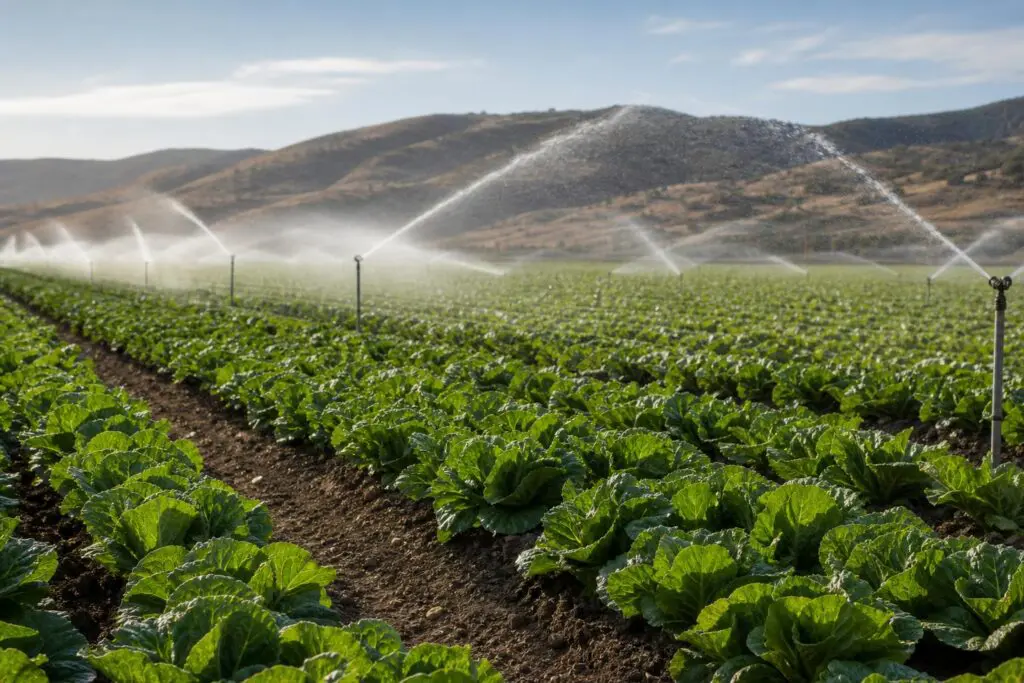
For scheduling, UC identifies CropManage as a tool that can help estimate irrigation amounts and frequency for most Salinas Valley vegetable crops. Its recommendations can be adjusted for crop development stage, soil type and irrigation-system characteristics. For sprinkler-irrigated crops, the advisors also describe short applications during the hottest period as a way to reduce air temperatures.
For growers encountering similar silvering, UC recommends contacting a local Cooperative Extension office for diagnostic help. In the Castroville case, the useful clues were the combination of symptoms, the absence of expected thrips signs, the negative INSV test and the restriction of damage to one experimental line, not leaf color alone.