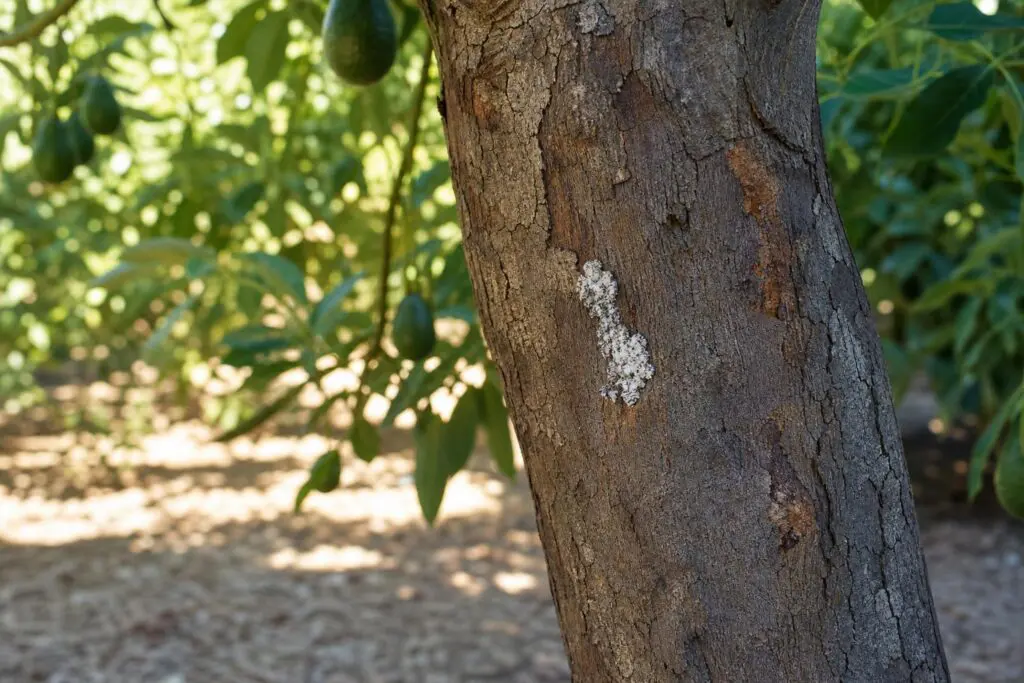
White deposits on avocado trunks and limbs can point to very different problems, from a bark wound to canker disease or invasive shothole borer activity. UC Agriculture and Natural Resources guidance published Nov. 9 explains a critical distinction for growers investigating cankers: some are associated with water stress, while another develops where trunks stay moist.
The white material alone does not identify the cause. In its avocado canker guidance, UC ANR explains that wounds allow sap to escape and crystallize on the bark. Physical damage and disease can both produce those sugary deposits. A separate October UC ANR pest guide describes white powdery material among the signs accompanying invasive shothole borer attacks.
That overlap makes the surrounding symptoms important. The location and pattern of a canker, evidence of bark injury, irrigation conditions and the presence of tiny round holes offer different clues. The guidance supports looking beyond the white patch rather than treating every deposit as evidence of the same disease or the same water-management problem.
Separate wounds from stress-associated cankers
Even an ordinary wound can leave a conspicuous deposit. UC ANR identifies the crystallized material as the sugar mannoheptulose or its alcohol form, perseitol. Bark damage from woodpeckers or people climbing trees can release it. Diseases that wound the bark can do the same, so the deposit is a reason to investigate, not a diagnosis.
UC ANR associates bacterial canker, Botryosphaeria canker, formerly called Dothiorella canker, and black streak with water stress. Its guidance says these problems often appear after low-rainfall years or where irrigation pressure is insufficient, emitters are clogged, or water and salinity stress have developed. It also notes that cankers can become conspicuous after heat waves.
For those stress-associated problems, UC ANR directs attention to irrigation performance: clogged emitters, low pressure, poor system design, infrequent irrigation and inadequate leaching. The guidance says symptoms can sometimes subside after the stress is corrected, provided damage is not too extensive. That qualification matters because the fungal infections can weaken wood, and young trees can die.
Canker patterns provide additional clues, though they do not settle identification. UC ANR describes black streak as small, scattered cankers with blackening around affected areas. Bacterial cankers can be roughly silver-dollar size and run in a line along a trunk or branch. Botryosphaeria cankers can occur anywhere on the trunk or branches, and several symptom types can occur on one tree.
Wet trunks present a different problem
Persistent moisture against the trunk points toward a different concern. UC ANR attributes another canker disease to Phytophthora mengeii, previously known as P. citricola. Conditions favoring it include irrigation water striking the trunk and moisture lingering on the north side where morning dew does not dry. Here, the concern is a wet trunk rather than insufficient water delivery.
UC ANR describes these Phytophthora cankers as occurring about 18 inches above the ground and gradually girdling the tree. The disease progresses more slowly than avocado root rot, but it can still kill young trees rapidly. The guidance emphasizes keeping irrigation water off trunks, a different focus from correcting inadequate delivery elsewhere in the irrigation system.
Rain can also change what a grower sees. UC ANR says rainfall washes away white exudate, making cankers harder to locate. A wet winter can therefore obscure visible deposits. The absence of a white patch after rain should not be mistaken for evidence that an earlier bark problem has necessarily disappeared.
Check for shothole borer entry holes
Invasive shothole borer adds a pest-related look-alike. UC ANR lists avocado among its hosts and describes perfectly round entry holes about 0.85 millimeters across, less than 0.04 inches. Associated signs include staining, gumming, white powdery exudate and frass. The guide identifies holes of the correct size and shape as the strongest visual clue to infestation.
For suspected invasive pest activity, UC ANR advises contacting the local county agricultural commissioner or UC Cooperative Extension office. Its scouting guidance also flags canopy thinning, branch dieback, bark holes and powdery residue as signs worth investigating. Reporting those observations provides a route to local help without assuming that white material alone identifies the pest.