Protecting coast redwoods after wildfire requires more than keeping the largest surviving trees alive. UC Agriculture and Natural Resources guidance recommends managing the surrounding forest as well, reducing the smaller trees and connected fuels that can carry another fire into mature crowns. For landowners, the goal is to protect surviving giants while helping younger stands develop the varied structure that makes mature redwood forests distinctive.
The October 2026 guidance, prepared by Blake Shaw, Brian Woodward and Claire Gregory, describes a phased approach that starts within or beside mature groves and extends into adjacent second growth as resources allow. It pairs with a March 2026 assessment factsheet by Daylin Wade and Susie Kocher that explains how to map fire effects and weigh tree species, safety, economics and ownership goals before choosing treatments.
A living tree can still lose critical structure
Large redwoods have substantial defenses against fire. Thick bark slows heat transfer to the cambium, the living tissue beneath the bark. They also can sprout from their bases and stems to replace lost canopy, an ability uncommon among conifers. Younger redwoods share that recovery mechanism, but they are more likely to lose their aboveground stems and regenerate from the base, potentially leaving a denser stand.
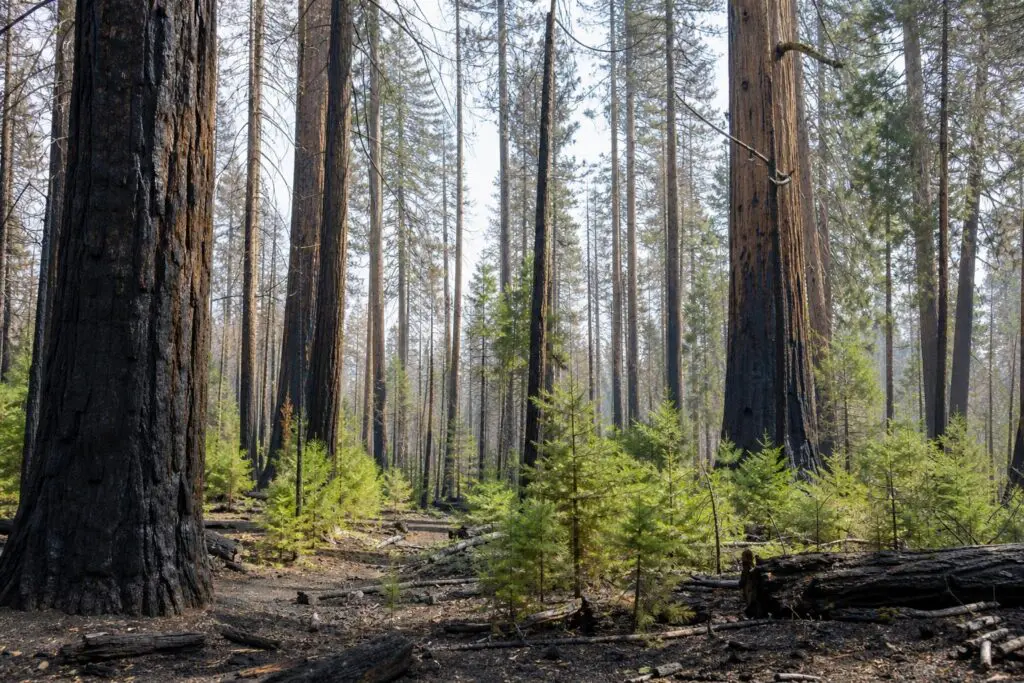
Survival, however, does not mean a forest has retained its habitat structure. Shaw and colleagues point to the 2020 CZU Lightning Complex as an example: large legacy trees survived in places where severe fire reduced upper crowns, damaged or killed large limbs and altered habitat features that take decades to rebuild. Those losses matter even when the largest trunks remain standing.
Old growth is an ecosystem condition, not simply a collection of old trees. The authors describe large-tree dominance, multiple canopy layers, complex crowns, standing dead trees and downed logs. Older redwoods can form repeated trunk-like structures and extensive limb networks that support plants such as ferns. Together, these features help sustain a cool, humid microclimate and diverse plants, fungi, invertebrates and wildlife.
Map damage before choosing treatments
A property-level assessment provides a starting point for deciding where work belongs. Wade and Kocher define fire severity through overstory tree mortality: low-severity fire leaves most overstory trees alive, moderate severity kills some, and high severity kills most or all across an area. Because effects can differ within one property, they recommend mapping patches rather than treating the entire ownership as uniformly burned.
Their factsheet describes mapping with a handheld GPS device, a smartphone mapping application, or a paper map and compass, with navigation experience needed for accurate paper-map locations. Species identification belongs alongside that map. Some trees depend on surviving seed sources, others release seeds after heat opens their cones, and redwoods and many hardwoods can resprout. Those differences shape what recovery may require.
Assessment also needs to account for delayed mortality. Trees weakened by fire can die over the following several years from stressors including drought and insect attack, Wade and Kocher explain. Foliage damage and injury to the cambium help inform survival estimates. Their general guidance specifically excepts redwoods from the rule that conifers cannot survive a completely scorched or consumed crown, underscoring the need for species-specific judgments.
Work outward from mature groves
For mature redwood groves, Shaw and colleagues describe an “Old Growth Out” strategy: retain large legacy trees and begin reducing ladder fuels within or adjacent to the grove, then work outward. Small conifers and a dense hardwood middle layer can connect surface fuels to live crowns. These layers can develop quickly after fire, especially where crown loss allows more light to reach the ground.
The authors recommend targeting smaller and mid-sized trees to reduce crowding and vertical fuel connections while encouraging larger remaining trees to grow. They also favor spatial variety, with lower-density patches interspersed with denser areas, rather than making every acre look alike. Variable-density thinning can help redirect the uniform spacing and simplified canopy structure common in second-growth stands toward a more varied forest.
That surrounding forest is central to the approach. Many old redwood groves stand as islands within second growth shaped by historical logging, dense regeneration and fire exclusion, the authors explain. Managing those neighboring stands serves two related purposes: buffering mature crowns from future fire and giving younger trees room to develop larger crowns and other old-growth characteristics. Rebuilding that structure takes longer than a single treatment.
The guidance calls for phased work and ongoing monitoring, not an attempt to recreate historical conditions all at once. Shaw and colleagues recommend consulting a California Registered Professional Forester to refine options for the site, project objectives, funding and applicable requirements. Wade and Kocher likewise emphasize matching short- and long-term decisions to the owner's needs and abilities. The practical sequence is to assess the damage, identify what remains, and plan work that protects those surviving structures while guiding the next forest.