UC Agriculture and Natural Resources reports that students surveyed in 2025 and 2026 gained new understanding of agricultural spray engineering, with most identifying information relevant to their career choices. The findings connect agricultural technology education with career awareness, although they measure what students said they learned rather than tested knowledge or subsequent education and employment.
In its November 2026 program account, UC ANR reported that 13 of 25 students in 2025, or 52%, said they learned “a lot” or “a great deal.” In 2026, 12 of 14 students, or 86%, selected those responses. Across both years, 32 of 39 respondents said they learned something that might apply to their career choice.
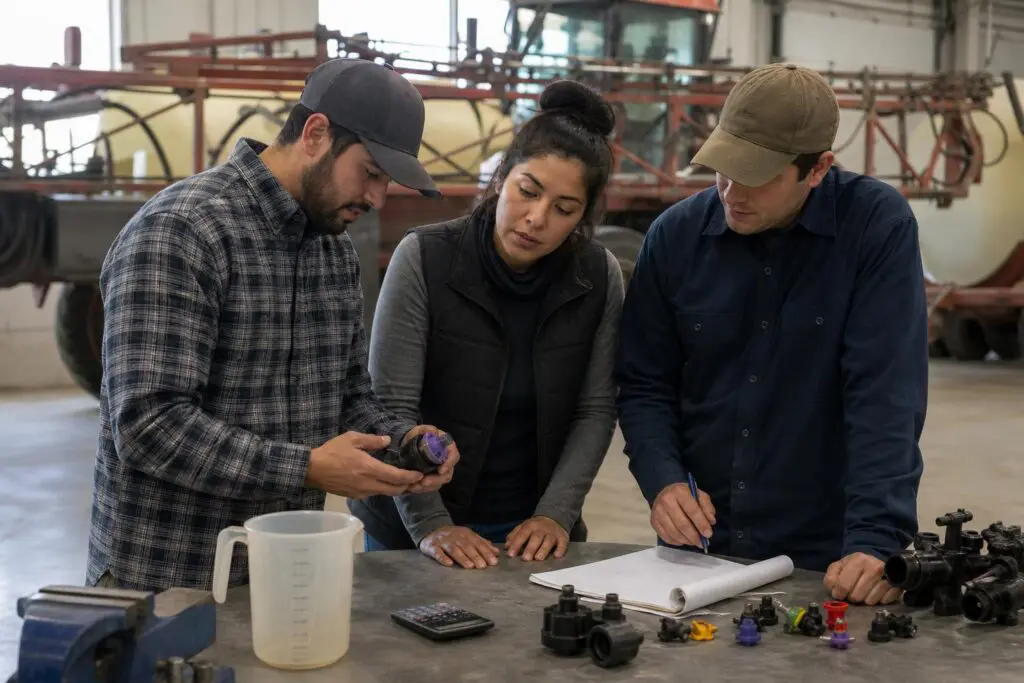
The results concern the Agricultural Application Engineering Program led by UC Cooperative Extension specialist Peter Ako Larbi at the Kearney Agricultural Research and Extension Center. Its work links machinery and engineering with agricultural production, including spray-application technology, decision-support systems, sensors, automation and coding.
UC ANR identifies a visibility problem behind that educational effort: students may know science, technology, engineering and mathematics as classroom subjects without recognizing their applications in agriculture. Agricultural and biological engineering offers connections to machinery systems, precision agriculture and environmental stewardship that students may not associate with engineering careers.
Interest and exposure are different measures
Engineering was the most frequently selected STEM interest among the student respondents in both 2025 and 2026, accounting for approximately 44% each year. Interest, however, did not mean that all students arrived with extensive experience. The surveys captured students with differing levels of prior exposure to STEM subjects.
Technology had the largest share reporting medium or high exposure: 82% in 2025 and 80% in 2026. For engineering, those shares were 60% and 55%. Mathematics stood at 50% in both years. These responses describe the students surveyed, not STEM exposure among Central Valley students generally.
The broader learning measure also showed positive responses. In 2025, 20 of 25 students, or 80%, reported at least a moderate amount of learning. All 14 respondents in 2026 met that threshold. No student in either year reported learning nothing, according to UC ANR.
Those findings distinguish two questions that matter for career education: whether students believe they encountered new information, and whether they see a possible use for it. The combined career-choice result, 32 yes responses and seven no responses, addresses perceived relevance. It does not show that students selected agricultural engineering majors or entered related jobs.
Separate assessments, different scales
An earlier UC ANR assessment provides another student perspective. In an account published in May 2025, all 15 undergraduate respondents reported “much” or “very much” learning overall about spray-application technology. UC ANR also reported that learning ratings varied by topic, with students valuing some content more than other material.
That assessment used four response categories: “None,” “Not Much,” “Much” and “Very Much.” The later student assessment used different wording, including “a lot” and “a great deal.” Keeping those scales separate avoids presenting the accounts as a single standardized test or treating their percentages as directly interchangeable.
UC ANR also reported positive learning responses from STEM educators in a separate account published in September 2025. Fifty-three percent of a 15-person group provided feedback. Every respondent reported learning between “a moderate amount” and “a great deal” overall. That finding applies to the respondents, not automatically to all 15 educators.
The educator account frames agricultural research as a source of classroom connections among science, mathematics and computer science. Its stated educational aim is to help students recognize scientific work outside textbooks. The reported feedback concerns educators’ own learning, however, rather than measured changes in their students’ understanding.
What the results can show
Taken together, the assessments cover different audiences and use different survey scales. Their common result is positive self-reported learning. They do not establish equivalent gains across groups, and the higher percentage choosing the strongest learning responses in 2026 does not by itself demonstrate that instruction became more effective.
The practical boundary is clear: these are small-group program evaluations, not evidence of improved pesticide application, lasting knowledge retention or demonstrated workforce outcomes. UC ANR’s stated objectives include developing and evaluating spray technologies and deploying decision-support systems. The education results show participants recognizing learning and, for many students, career relevance. Whether that interest carries into later study or work remains unanswered.