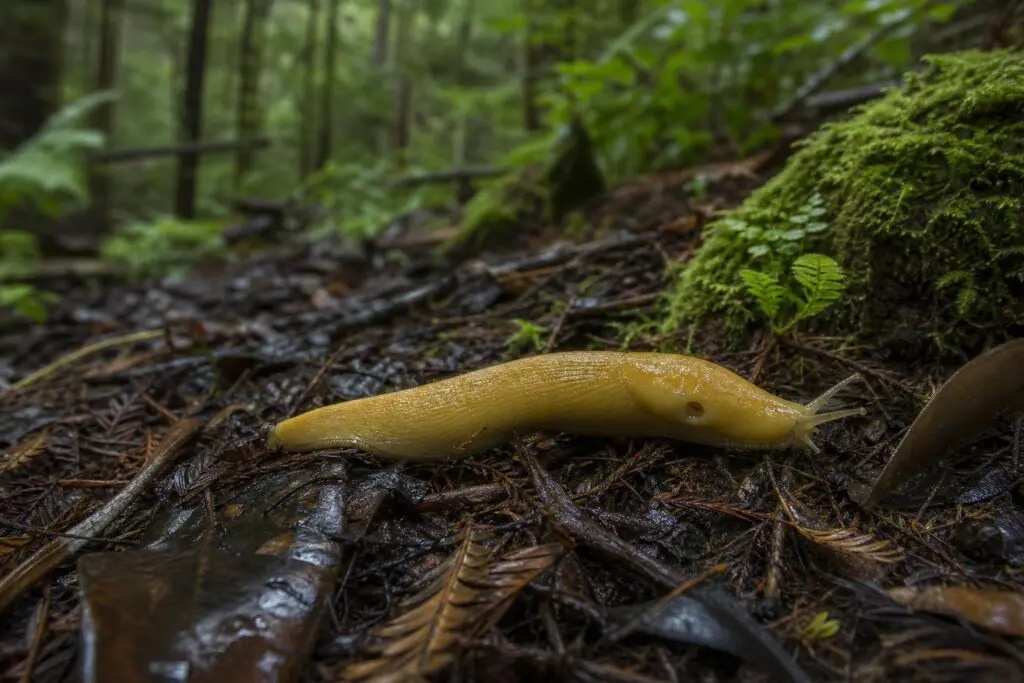
Two nematode-based products developed to control agricultural pest slugs also killed native Pacific banana slugs in an Oregon State University laboratory study announced Nov. 12. The findings add a second native species to the university’s research on potential unintended effects as efforts continue to bring the products to U.S. markets.
The California connection is the animal itself: Pacific banana slugs range from Alaska to California. Researchers tested animals collected on the Oregon coast, not California farms. Their results identify a laboratory hazard to a native species, but do not demonstrate exposure or population losses under field conditions.
OSU researchers Dee Denver and Emily Taylor led the experiment, which tested two products marketed as Nemaslug and Nemaslug 2.0. Both use tiny parasitic worms called nematodes. According to Denver, the products are not currently permitted in the United States because knowledge remains limited about their effects on native and other non-target species and their North American distribution.
Two products, different mortality results
The study involved 178 juvenile and adult banana slugs collected in spring 2024 and followed through a 38-day experiment. The Nov. 12, 2026, announcement therefore reports findings from animals collected more than two years earlier, rather than from a newly started trial. The research was published in PLOS One and funded by the U.S. Department of Agriculture.
Every banana slug exposed to the original Nemaslug died, OSU reported. That product uses the nematode identified in the latest announcement as Pellioditis hermaphrodita. The worms enter openings in a host slug’s body, cause a fatal infection, reproduce inside the dead animal and then disperse in search of other hosts.
Nemaslug 2.0, based on a different nematode, P. californica, was not uniformly lethal to banana slugs. Nevertheless, 80% of exposed juveniles died. Survival was substantially higher among unexposed animals: 84% of juvenile controls and 96% of adult controls lived through the experiment. Those results show that young banana slugs were vulnerable to the second product as well.
Earlier snail trial raised similar concerns
The banana slug findings follow a separate OSU study announced in March 2024 involving Pacific sideband snails, a native woodland species of the Pacific Northwest. That earlier experiment examined the original Nemaslug over 10 weeks. All 90 exposed snails died by the end of the study, while all 30 unexposed control snails survived.
In the sideband experiment, the speed of death varied with the concentration of the product and the snails’ size and maturity. Denver said at the time that researchers needed to investigate effects on non-pest slugs and snails in conditions resembling their natural environments before the product became available in the United States.
The newer experiment extends that line of research from a native snail to a native slug and includes both commercial formulations. It does not make the two trials interchangeable: they involved different animals and ran for different lengths of time. Both were laboratory studies from OSU teams with overlapping researchers, rather than independent institutional confirmations.
Pest control benefits face non-target questions
The agricultural interest centers on controlling damaging invasive pests such as the gray field slug. OSU says nematode products are already sold in several countries, and Denver reports continuing efforts to bring them to the United States. The safety question is whether organisms used against pest slugs could also infect native species that are not the intended targets.
Denver and his colleagues say unintended effects of biological control on native slugs and snails remain understudied and difficult to predict. They also report that the two nematode species have been found in Oregon, although their distribution across the Northwest remains undetermined. That uncertainty matters alongside the laboratory findings when assessing potential exposure outside controlled experiments.
For California readers, the distinction is between demonstrated susceptibility and demonstrated field harm. The banana slug study establishes that a species native to the state can die after experimental exposure to these products. Whether comparable exposure occurs in natural settings, and what it would mean for wild populations, remains a question for further research.