Oregon State University is changing how it manages a former industrial timber property near Scappoose, combining timber harvests with retained trees, stream restoration and public recreation. The work at the 3,110-acre Tualatin Mountain Forest offers a working example of how terrain, habitat and access can shape decisions beyond how much timber to remove.
In a Nov. 3 update, OSU Extension described management underway since the university acquired the forest in 2025. It is OSU’s only research forest in the Portland metropolitan area. The university plans to use the property for timber production, ecological diversity, research, education and recreation, rather than manage it around a single purpose.
The ownership transfer came with lasting obligations. Trust for Public Land acquired the property using U.S. Forest Service Forest Legacy Program funding, Metro funding and private gifts, then transferred it to OSU at no cost to the university. According to OSU, those funding arrangements require active forest management and public access to continue in perpetuity.
Much of the forest now consists of Douglas-fir stands with trees of relatively similar ages. OSU plans to broaden the mix of species, ages and forest structures while studying different management approaches. An initial plan will direct near-term work as the College of Forestry develops a longer-term plan incorporating research, ecological and Tribal priorities.
Harvest layouts respond to terrain and trails
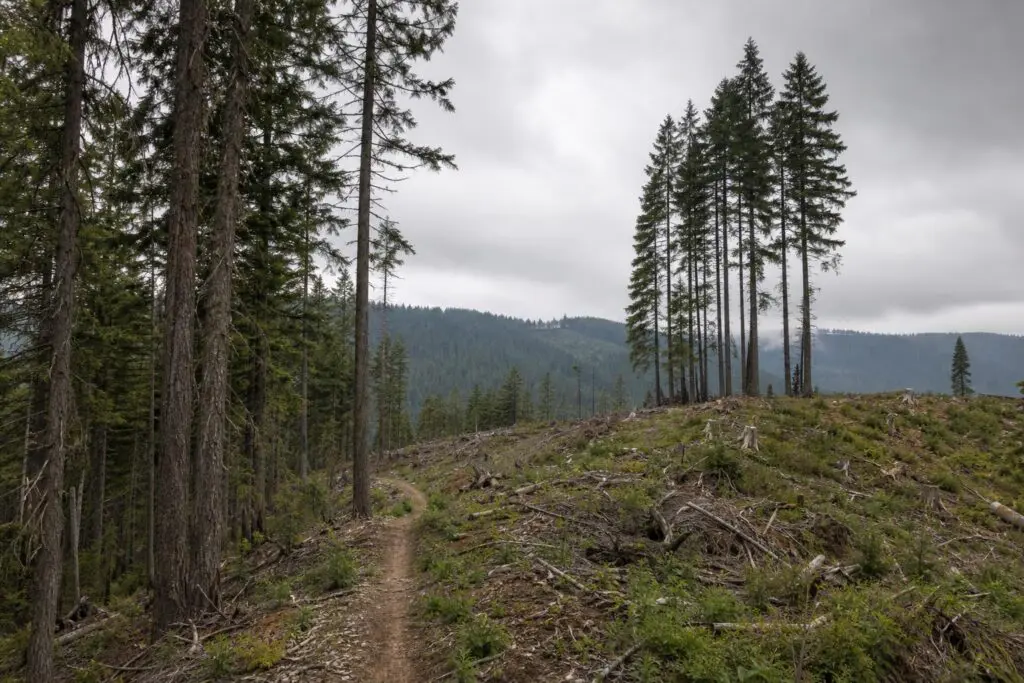
Recent harvests show how those objectives affect operations. In one harvested area, OSU left groups of standing trees along with wildlife trees, snags and downed wood. Extension forester Jake Barker said the retained patches also preserve roots, fungi and other below-ground systems that could help support regeneration nearby. That potential benefit remains a management rationale, not a demonstrated research result.
Some retained patches surround mountain bike trail switchbacks that would be difficult to rebuild after logging. On another hillside, crews used a cable system to move logs uphill to a landing and left strips of trees along the upper portions of steep drainages. OSU said those strips went beyond what Oregon forest practice rules required.
The strips were positioned to protect soils and aligned with prevailing winds to reduce the chance of trees blowing down, Barker explained. He described the harvest layout as more operationally complicated than a uniform cut, but said it creates different habitat conditions within the same area. The design leaves openings interspersed with standing trees.
Stream crossings receive attention
Road and water work has accompanied harvesting. After acquiring the property, OSU inventoried roads and culverts and replaced several crossings. At Joy Creek, crews removed a poorly functioning culvert, retired an unnecessary stretch of road and restored the stream channel. These completed actions are separate from the university’s longer-term plans for studying forest management.
Local assessment adds a climate lens
Earlier OSU Extension guidance from Washington County helps explain why site conditions matter to such decisions. A May 26 account described Climate-Informed Forestry: Strategies for Washington County, Oregon, a locally developed guide offering choices based on site conditions, ownership goals, risk tolerance and economic constraints. It presents options rather than a single management prescription.
The guide’s assessment rates climate vulnerability as low, moderate or high using factors that include elevation, slope direction, soils, drainage and landslide history. Barker and retired Oregon Department of Forestry reforestation manager Mitch Taylor encouraged managers to compare maps, historical aerial images, elevation information and past land use with conditions observed on the ground.
Taylor also cautioned against attributing every damaged or declining tree to climate change. Disease, soil conditions, slope, past management and storm damage can contribute, he said, while climate stress can intensify existing problems such as root rot. That distinction keeps climate considerations alongside other forestry questions rather than allowing one explanation to replace a site-specific diagnosis.
At Tualatin, recreation will also be a research subject. OSU’s longer-term visitor planning will consider a broader range of uses, while current trail work focuses on restoring existing mountain bike routes rather than adding new ones. The university sees opportunities to study trail construction, visitor management and interactions between recreation and working forests as management continues.