Oregon State University Extension reports that research hedgerows planted in 2024 and 2025 attracted beneficial insects and provided overlapping blooms from early spring into late fall. For California growers considering field-edge habitat, those observations complement older local research showing pest-control benefits in processing tomatoes, but not a universal distance of protection or a guaranteed financial return.
In its Oct. 27 report, OSU Extension described plantings at three Oregon research centers. Researchers installed five hedgerows near different crops at the North Willamette center and one at the Mid-Columbia center in spring 2024, followed by another at the Southern Oregon center in 2025. The plant mix was designed to keep flowers available across the season.
Flowers across the growing season
Heather Andrews, a senior faculty research assistant with OSU Extension, reported that goldenrod, Pacific ninebark and oceanspray attracted a range of beneficial insects. Perennial sunflower supplied nectar for lacewings and lady beetles before flowering and continued blooming into October. These are Oregon habitat observations, not demonstrations that those plants will deliver the same results on California farms.
The seasonal pattern is the useful connection: a hedgerow can offer food over time rather than a single burst of flowers. California researchers also used successive, overlapping bloom periods when selecting native shrubs for an earlier field study. That study went beyond insect visits to compare pest populations and pest control in adjacent processing tomatoes.
What California tomato fields showed
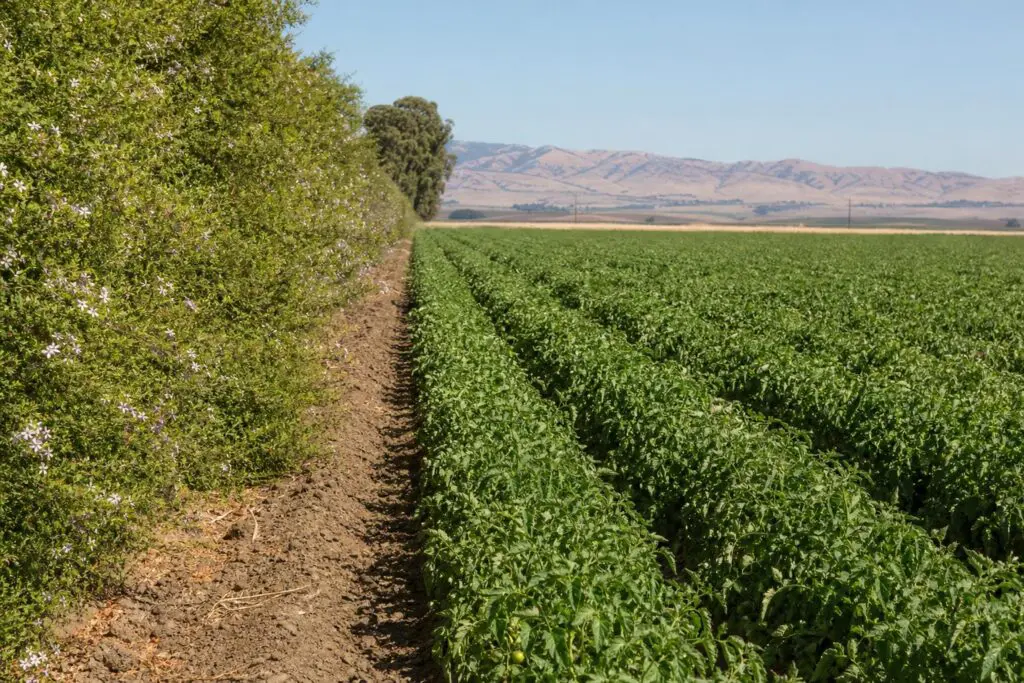
Lora Morandin, Rachael Long and Claire Kremen published the California findings in 2014, using fieldwork conducted in Yolo County during the 2009 and 2010 growing seasons. They compared established native perennial hedgerows with semi-managed weedy field edges. Across the two years, the study included six distinct hedgerows and six distinct comparison edges.
These were mature plantings, not newly installed borders. The hedgerows had been established between 1996 and 2003 and included native shrubs bordered by perennial grasses. Researchers matched hedgerow sites with nearby tomato fields that had similar planting dates, allowing them to compare field-edge habitat types under broadly similar regional conditions.
Inside the hedgerows, economically important pests were less abundant and parasitoid wasps were more abundant than in the weedy margins. Total predatory arthropod abundance did not differ between edge types, although hedgerows supported a greater variety of predators. That distinction matters: more kinds of beneficial organisms did not necessarily mean more predators overall.
Within tomato fields, the researchers found more predatory lady beetles and fewer aphids next to hedgerows, with differences observed as far as 200 meters into the crop. That was the farthest distance sampled, not a demonstrated endpoint. Pest-control benefits from parasitism extended to 100 meters, but were not found at 200 meters.
Fewer fields beside hedgerows reached pest thresholds requiring insecticide application. The findings support a pest-management role for field-edge habitat in that study, but the measured distances describe particular responses in Yolo County processing tomatoes. They are not a spacing rule for every crop, landscape or pest, and do not show that every benefit reaches equally far.
Payback depends on the benefits counted
The same research team examined the financial question in a separate 2016 paper. Its model used a $4,000 establishment cost for a typical 300-meter hedgerow. Counting insecticide savings alone, the authors estimated a 16-year break-even period. Those are historical model inputs and results, not a current installation quote or a promised repayment schedule.
When the model added native-bee pollination benefits under conditions where honey bees might be limiting, the estimated return period shortened to seven years. The change illustrates how strongly the calculation depended on which benefits were counted. A pollination benefit assumed for that scenario cannot simply be added to every farm's expected hedgerow income.
The authors also found that USDA cost sharing could shorten the return period in their analysis. For a present-day investment, however, the seven- and 16-year estimates remain conditional historical comparisons. The difference between them turns on a concrete question: whether a planting provides only pest-control savings or also delivers an economically useful pollination benefit.