Drilling a declining palm to test for Fusarium wilt can leave permanent damage without a clear diagnostic benefit. In a Q&A published Nov. 16 by University of California Agriculture and Natural Resources, palm expert Don Hodel cautioned against trunk drilling, explaining that palms cannot grow over those wounds and that the openings can admit pests and diseases.
For California nursery and landscape professionals, the guidance highlights a distinction: the palm species and the Fusarium wilt pathogen involved affect which tissue may yield the organism. Hodel said the original Fusarium wilt can be isolated from leaves, while the newer disease is best isolated from trunk tissue. That does not make drilling an established sampling method.
Two pathogens, different host ranges
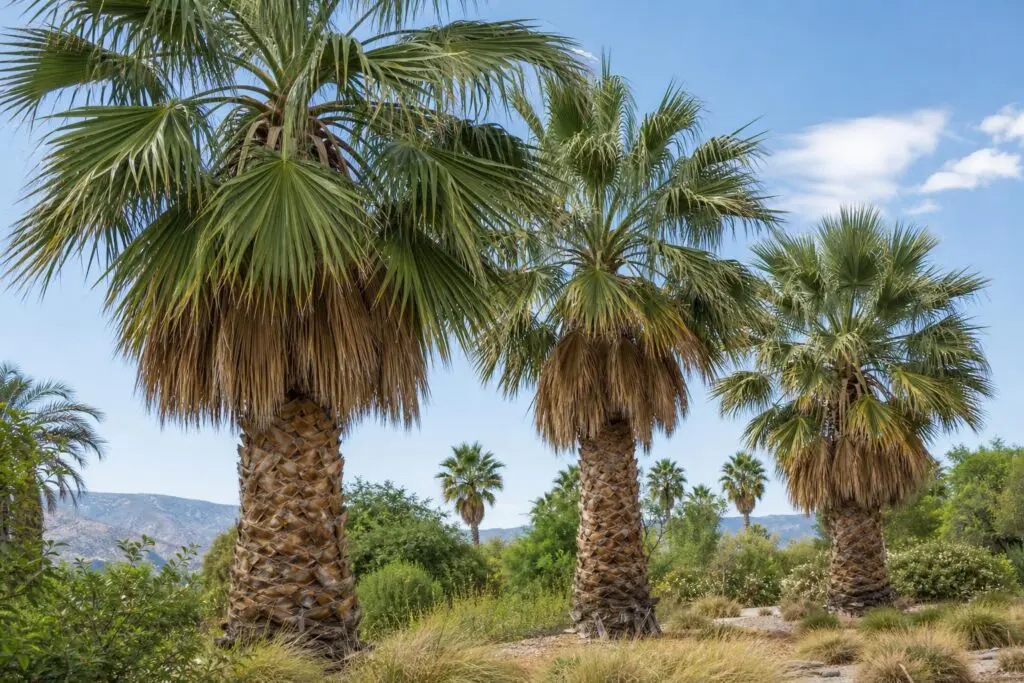
Two pathogens underlie that distinction. In their 2020 paper, Donald R. Hodel and Paul Santos described the traditional Fusarium wilt of Canary Island date palm, caused by Fusarium oxysporum f. sp. canariensis, and Fusarium wilt of queen palm and Mexican fan palm, caused by Fusarium oxysporum f. sp. palmarum. Similar disease names do not mean identical host ranges.
The authors described the traditional disease as attacking Canary Island date palms in the landscape. The palmarum pathogen has a broader host range. Their paper identified queen palm and Mexican fan palm as hosts, while also reporting infections of Canary Island date palm and, rarely, mule palm in Florida. Those Florida observations should not be read as California detections.
The California confirmation on Mexican fan palms dates to September 2020, not this November. Hodel and Santos reported that California Department of Food and Agriculture plant pathologists identified the palmarum pathogen in samples collected the previous month from dying palms in the Playa Vista section of Los Angeles. The November publication offers guidance, rather than announcing that historical detection.
Symptoms and laboratory confirmation
Both diseases can produce a similar progression through the canopy. The authors’ comparison describes lower, older leaves dying first, followed by leaves farther up the palm. Individual leaves may initially die on one side, and dark brown streaking can appear inside and outside the leaf stalk and central leaf axis. These shared features help explain why the diseases can look alike.
The symptoms reflect damage to the palm’s water-conducting tissue, or xylem, Hodel and Santos wrote. In Mexican fan palms, segments on one side of a leaf may yellow and die before the opposite side follows. But the pattern is not always neatly one-sided: the authors also described wedge-shaped areas of yellowing or dead tissue within otherwise green leaves.
Hodel’s November answer says symptomatic canopy leaves are typically sufficient to identify Fusarium wilt. The older research nevertheless shows why recognizing a disease pattern and obtaining laboratory confirmation are different tasks. Before the Mexican fan palm confirmation, Hodel and Santos had submitted leaf samples from symptomatic palms over several years without a likely pathogen being identified.
The authors subsequently learned that tissue from the lower or basal trunk was likely the best material for detecting the palmarum pathogen. Their 2020 account describes taking down symptomatic Mexican fan palms, collecting samples and submitting them to CDFA through the Los Angeles County Agricultural Commissioner. That history documents a successful investigation, not a validated drilling procedure for standing palms.
Permanent wounds and persistent soil risk
In the November Q&A, Hodel explicitly left drilling unresolved. He did not know whether drilling into a trunk would provide tissue suitable for culture, whether it was necessary or whether it was a good idea. His warning rests on palm biology: palms lack the secondary growth that would allow them to cover a trunk wound, leaving the opening permanently exposed.
The guidance also addresses the ground beneath affected palms. Hodel said Fusarium wilt can remain active in soil for at least 25 years and infect a newly planted Canary Island date palm. That answer is specifically relevant to replanting that species; it should not be treated as a measured soil-survival period for both pathogens or every susceptible palm.
Watering history presents another diagnostic distinction. Asked whether overwatering can cause Fusarium wilt, Hodel answered no: the Fusarium pathogen causes the disease. His guidance separates that cause from irrigation conditions, just as it separates useful tissue for isolation from an acceptable way to collect it. For a standing palm, the unresolved value of drilling must be weighed against the permanent wound he describes.