Beginning gardeners learning to grow food on limited budgets are gaining confidence in crop selection, soil care and handling their harvests, according to a November 4 account from Oregon State University Extension. Its Seed to Supper program connects growing food with using it, but those experiences should not be confused with measured improvements in household food security.
For California readers interested in home food production, the Oregon program offers an example of instruction built around practical household needs. Separate research from San Jose, published in 2016, examined gardeners’ reported vegetable consumption. Together, the accounts address different questions: what gardeners learn, and how eating from a garden may relate to their diets.
Instruction built around a limited budget
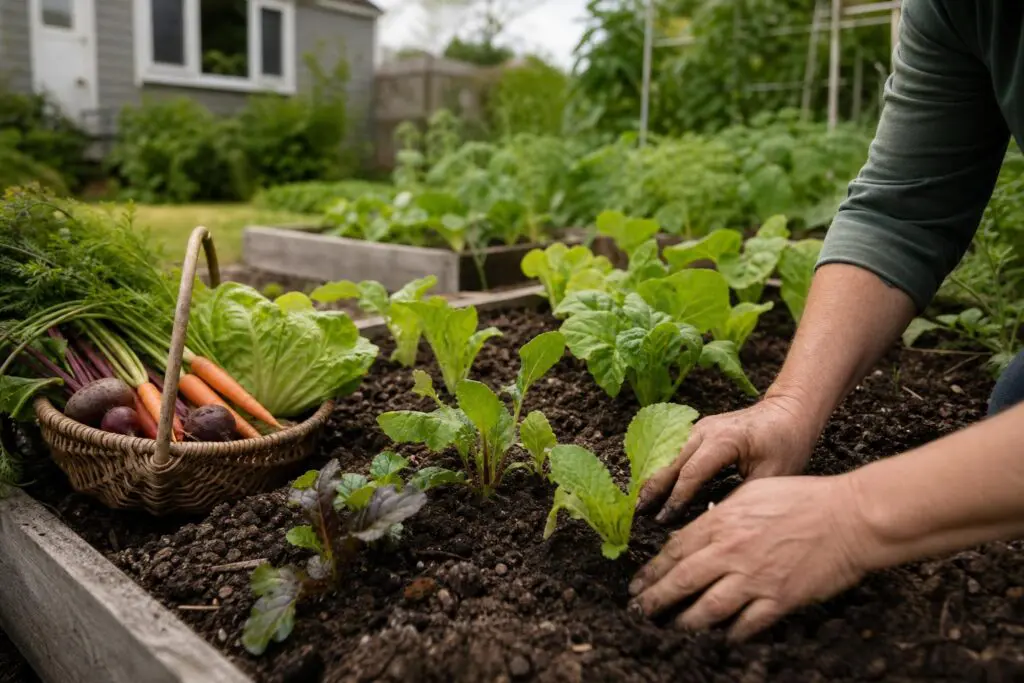
Seed to Supper is a free, six-week course for beginning adult gardeners who want to grow a portion of their food on a limited budget. OSU Extension now administers the program, which it developed with the Oregon Food Bank. Its curriculum is available in English and Spanish, with the Spanish version called Siembra la Cena.
The program’s stated focus is people with low incomes and those most likely to experience food insecurity. OSU says it has worked with organizations ranging from food banks and pantries to places of worship and prisons. That partnership model places gardening instruction alongside organizations already serving people who may face difficulty getting enough food.
OSU’s recent account describes learning that extends beyond planting: understanding soil, choosing crops, managing pests, harvesting and preparing for another season. Participant Aria Juchmes told the university that lessons about soil care helped them feel more confident making garden decisions. Jose Lira described trying unfamiliar peppers and flowers and learning that crops require different amounts of water and care.
Other experiences show why a productive crop is only one part of learning to garden. According to OSU, Jennifer Langston had abundant eggplant while her usually reliable tomatoes struggled. Hearing that other gardeners faced similar problems helped restore her confidence. She also found ideas in the experiences of people gardening in apartments and other small spaces.
Following food beyond the harvest
The teaching model follows food beyond harvest. OSU Master Gardener volunteer Shannon Lambert described instruction that starts with what participants want to eat, then covers growing, cooking, saving the harvest and preparing the garden for the next year. OSU’s account includes discussion of preserving surplus produce, rather than treating a successful harvest as the final step.
The curriculum nevertheless has a geographic boundary: OSU designed it for the maritime Pacific Northwest. Its program guidance encourages providers to adapt materials to their own climates. California readers should distinguish the broader educational approach from regional growing guidance, rather than treating Oregon crop timing or seasonal examples as a California planting calendar.
What the California research measured
The California research provides a different perspective. Susan Algert, Lucy Diekmann, Marian Renvall and Leslie Gray studied 85 community gardeners and 50 home gardeners in San Jose. Their pilot study appeared in California Agriculture in 2016 and used surveys collected during 2012 through 2014. It was not an evaluation of Seed to Supper.
The researchers asked gardeners about their usual vegetable intake and how much more they ate when consuming produce from their gardens. Participants reported roughly doubling their vegetable intake to a level meeting the dietary recommendations cited in the study. The authors described home and community gardens as potential contributors to access to fresh vegetables.
Those results came with substantial limits. The researchers relied on participants’ own estimates of what they ate, and they explicitly warned that respondents might have overstated consumption. The study also lacked a control group. Its findings therefore do not establish that gardening alone caused the reported dietary change or demonstrate the effectiveness of a current gardening course.
The San Jose surveys also explored food access beyond vegetable quantities, including cost savings, culturally acceptable foods and sharing produce. That broader scope distinguishes food security from confidence in growing a crop. In Oregon, OSU’s participant accounts describe practical learning and mutual support; in the older California study, researchers asked how garden harvests fit into household diets and access to food.