California faces increased odds of a wet winter, but El Niño does not guarantee rain on any particular farm. As growers weigh that outlook, a UC Agriculture and Natural Resources trial offers a separate, field-level finding: cover-cropped vegetable ground in the Salinas Valley absorbed more rainfall and produced substantially less runoff than bare plots during winter 2025-26.
NOAA’s October 13 briefing put the probability of a very strong El Niño at 96% for November 2026 through January 2027. Seasonal model forecasts in that briefing favored above-normal precipitation across much of the Southwest, with probabilities exceeding 60%. That regional outlook is not a rainfall forecast for an individual California field.
A wetter outlook, not a rainfall guarantee
Daniel Swain, a climate scientist with UC ANR’s California Institute for Water Resources, explained the California implications in an August fact sheet. Very strong El Niño conditions favor a wetter-than-average winter, particularly in central and southern California, he wrote. They also tilt the odds toward individual heavy precipitation events that can increase inland flood risk.
UC ANR circulated Swain’s fact sheet again on October 27. His central caution remains important: even a very strong El Niño does not guarantee specific California rainfall or flooding outcomes. Consequential flooding can occur in any winter, regardless of El Niño. The outlook changes the odds, rather than establishing how much rain will fall or where flooding will occur.
Testing where winter rainfall goes
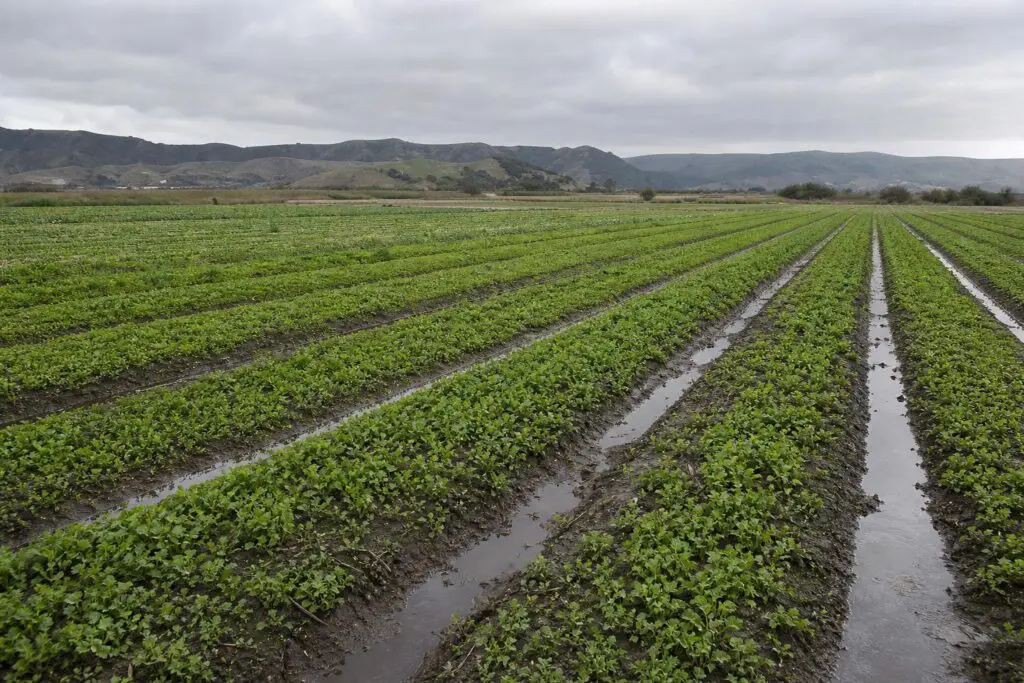
The Salinas Valley experiment addressed a different question: how much winter rain enters the soil instead of leaving a field as runoff? Published by UC ANR in September, the trial compared cover-cropped and bare fallow plots in a bedded vegetable field on the valley’s east side. It measured the preceding winter, not the forecast 2026-27 season.
The site had Gorgonio sandy loam soil and a 2% slope. Researchers seeded sudangrass in late September on 40-inch-wide beds and in the furrows. Each plot covered about an acre, extending eight beds across and 1,650 feet down the field. Each treatment was replicated three times, allowing comparisons within the same field setting.
Researchers installed flumes at the lower ends of the plots to measure runoff and used automated equipment to collect water samples. A rain gauge recorded rainfall at 15-minute intervals. From late September 2025 to early March 2026, the site received 13.8 inches of rain, close to the region’s long-term average rather than an exceptionally wet seasonal total.
Runoff monitoring covered November 12 through March 6, when 11.6 inches of rain fell. During that period, cover-cropped plots infiltrated an average of 92% of rainfall, compared with 62% in bare plots. The researchers reported 79% less runoff under the cover crop, providing a measured comparison of how the two treatments handled the same winter’s rainfall.
The infiltration difference amounted to an additional 3.4 inches of water entering the soil in the cover-cropped plots, or 48% more than in bare plots. That result concerns infiltration at the field site. It should not be read as a measurement of water reaching an aquifer, which is a different outcome from rainfall entering the soil.
Less runoff also meant less soil loss
The runoff difference also affected soil loss. UC ANR reported that bare plots lost 4,014 pounds of sediment per acre during the winter, compared with 35 pounds per acre from cover-cropped plots. Together, lower runoff volume and lower suspended sediment concentrations produced an average 99% reduction in erosion in the cover-cropped treatment.
Seasonal totals did not tell the whole rainfall story. Much of the trial’s precipitation arrived in three atmospheric river events in November, January and February, each contributing 2 to 4 inches. Thus, the near-average winter still exposed the plots to concentrated storm rainfall, allowing researchers to compare runoff and erosion during those events.
Those results apply to one site, soil, slope and winter, not every vegetable field or an unusually wet El Niño season. The trial also involved managing a cover crop within an existing bedded production system. NOAA’s forecast describes regional weather odds; the Salinas measurements show how one field treatment changed the fate of rain that actually fell.