As walnut growers head into November, autumn freeze preparation calls for checking more than crop water use. University of California Cooperative Extension guidance recommends keeping surface soil moist when late-October rainfall has been inadequate. The goal is to help orchard soil store daytime heat and release it at night, without leaving saturated soil or standing water.
That puts field moisture checks at the center of the decision. Regional evapotranspiration reports can help growers compare estimated water use with rainfall, but the freeze-preparation question is specific: Has enough moisture reached the soil near the surface? UCCE recommends answering it with rainfall and ET comparisons alongside checks by hand or with sensors.
The recommendations come from walnut freeze guidance by UCCE farm advisor Luke Milliron and farm advisor emerita Janine Hasey, updated in September 2022. Their advice connects autumn irrigation, orchard-floor management and continued monitoring through November and December, rather than treating one irrigation as the end of freeze preparation.
Aim for moist soil, not ponding
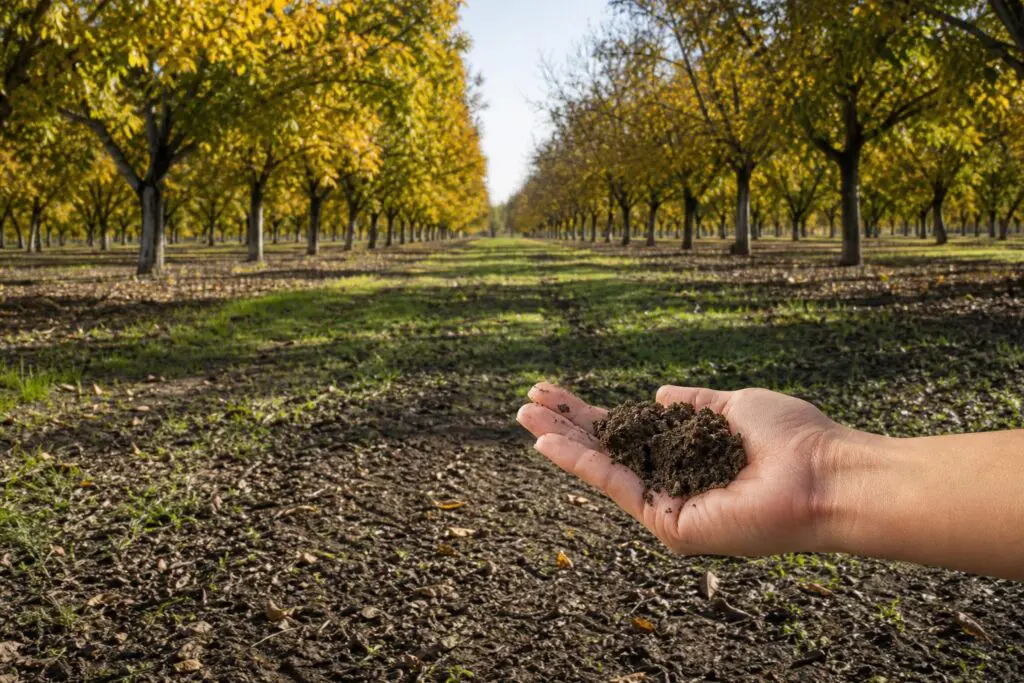
For freeze mitigation, Milliron and Hasey identify the top 12 inches of soil as especially important. They recommend keeping that layer at field capacity, if possible, rather than saturated or ponded. Trees with adequate soil moisture withstand low temperatures better than trees in dry soil, they explain, because water-filled soil spaces conduct and hold more heat than air-filled spaces.
Both extremes can work against that heat-storage benefit. A dry crust limits the release of stored daytime heat, but so can a frozen sheet of ponded water. The practical target is therefore moist soil without standing water, not simply the largest possible irrigation before cold weather.
Knowing how quickly each soil takes in water helps growers plan that irrigation, the authors advise. Their recommendation applies to both young and mature orchards when rainfall has not adequately moistened the surface by the end of October. It is conditional guidance, not a finding that every orchard needs water on the same date.
Manage the floor for heat storage
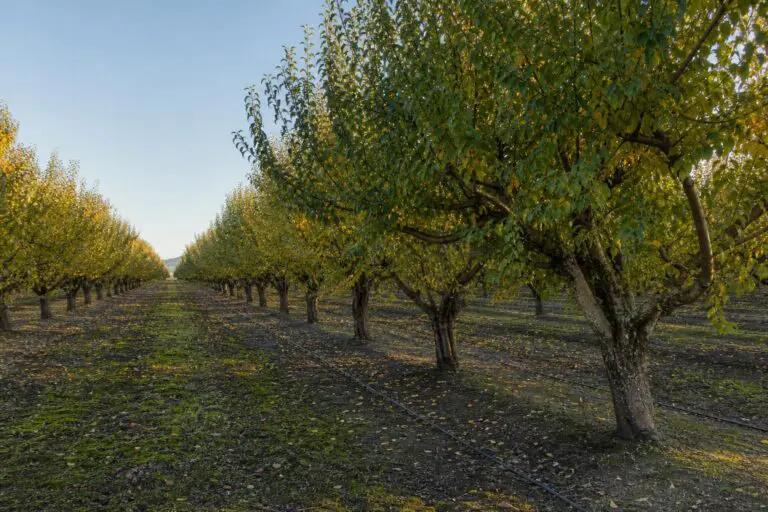
Groundcover management is part of the same heat-storage strategy. Milliron and Hasey recommend maintaining short groundcover beginning in mid-October and cutting it to 2 inches or less during frost season. That lets sunlight reach the soil surface, increasing the heat available to warm the orchard overnight.
Recently cultivated soil behaves differently. The authors describe it as having more air spaces, less capacity to store heat and lower heat conductivity, resulting in colder minimum temperatures. Bare ground also needs a moist surface to provide its warming benefit. Removing vegetation alone does not meet the moisture objective.
The northern Sacramento Valley ET report identifying the week of October 16-22, 2026, covers CIMIS stations at Gerber, Biggs and Williams. It offers regional context for water accounting. Its estimates assume managed orchard-floor vegetation, so growers should consider whether their own floor conditions match those assumptions when using the report alongside soil observations.
UCCE's explanation of the reporting method, updated in April 2021, says past-week and cumulative crop ET use measured weather, while the next-week estimate is a historical average, not a short-term forecast. Neither that projected crop use nor a rainfall comparison substitutes for a freeze forecast or an orchard soil check.
The same methodology explains that rainfall and stored soil water meet part of crop demand and reduce irrigation needs. For autumn freeze preparation, however, the moisture condition of the upper soil layer remains a separate check. A water-use estimate describes demand; Milliron and Hasey's guidance asks growers to confirm the surface soil can store heat.
Keep checking after the first frost
Milliron and Hasey recommend continuing to monitor soil moisture and freeze predictions through November and December until trees acclimate. Because frost conditions vary by location, they also recommend monitoring individual blocks with frost alarms. A regional ET report serves a different purpose from those local temperature warnings.
When a freeze is predicted and soil is dry, their guidance favors wetting it two to three days beforehand to fill soil air spaces and improve heat storage. They also describe light irrigation of a dry surface the morning before frost as helpful, provided no standing water remains during the freeze.
The endpoint is less certain than a calendar date might suggest. Milliron and Hasey say fully dormant, healthy mature walnuts can tolerate temperatures in the low 20s Fahrenheit or below, but trees must first acclimate. They believe early autumn frosts near 32 degrees contribute to acclimation; the number of frost events required remains unknown.
That uncertainty supports continued attention after an initial cold night. The authors advise maintaining freeze preparation longer for younger orchards with substantial current-season growth. For those blocks, checking surface moisture and watching local freeze predictions remain linked tasks even after the first autumn frost.