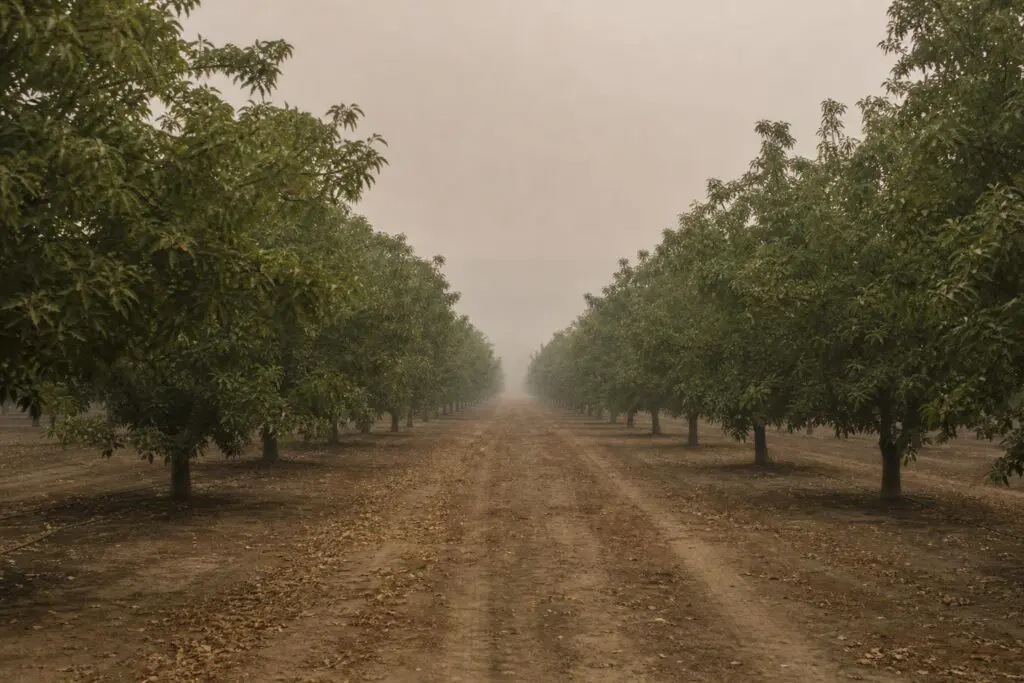
Heavy wildfire smoke can leave orchard trees with less stored energy for winter and spring, even after clear skies return. Research on California’s 2020 megafires found reduced carbohydrate reserves in nut trees, raising concerns about smoke exposure during the late-season period when orchards build the reserves that carry them into the following growing season.
In an October 28 report from West Coast Nut, Jessica Orozco, a Stanford postdoctoral fellow, and Maciej A. Zwieniecki, a UC Davis plant sciences professor, described findings from their study, Megafire Smoke Exposure Jeopardizes Tree Carbohydrate Reserves. Their work examined almonds, pistachios and walnuts. It concerns the effects of the 2020 fires, not a new smoke event.
The research drew on monthly orchard samples that Zwieniecki began collecting in 2017. Those records showed a seasonal pattern: before dormancy, nut trees accumulate sugars and starches that supply energy through winter and into spring bloom. Having measurements from before the fires gave the researchers a way to investigate changes after prolonged smoke exposure.
Why the timing of smoke matters
The researchers found lower starch and sugar reserves following the heavy smoke. Timing mattered: exposure during the period of reserve accumulation had a greater effect. Orozco said the reduction probably involved photosynthesis, but the researchers could not determine exactly which part of that process was affected or separate all the possible causes.
Smoke in May or June was less consequential because leaves still had time to photosynthesize afterward, the researchers reported. Exposure in August and September had a greater effect because it overlapped with preparation for winter. That distinction makes the season of exposure important to understanding orchard effects, rather than treating every smoky period as equivalent.
Duration and density also matter. Zwieniecki said prolonged mountain fires can expose orchards to smoke for 15 to 20 days or longer. Light smoke can scatter sunlight through more of a tree’s canopy, potentially increasing photosynthesis, while dense smoke reduces available light. Orozco said the point at which any benefit disappears remains uncertain.
Several possible pathways, no single confirmed cause
Smoke chemistry adds another complication because its composition depends on what burns. Ash on leaves and pollution-related changes in leaf function were possible explanations for the reduced reserves. But Orozco said the researchers did not measure ash deposition, and the study did not establish which component of smoke exposure had the greatest effect.
Zwieniecki also described unusually high near-ground ozone during the fire period, likely related to the fires. He explained that ozone can enter leaves through stomata, the pores involved in gas exchange, and trigger stress that causes those pores to close prematurely. That response can restrict photosynthesis, but it was not isolated as the main cause.
The researchers reported next-year yield declines ranging from 20% to 50%, depending on orchard proximity to fires. Those figures should not be read as an expected loss for every smoke-exposed orchard or for each of the three crops. Zwieniecki said obtaining reliable yield information was especially difficult for walnuts and pistachios because growers and companies considered it proprietary.
Stored carbohydrates are not a yield guarantee
An older UC-hosted presentation by Zwieniecki, Paula Guzmán-Delgado and Orozco explains why carbohydrate measurements alone cannot settle a yield forecast. Their yield-modeling work identifies geography, orchard age, variety, weather and management as relevant factors. Correlations between individual carbohydrate measurements and yield carry substantial error, even when the measurements offer useful information about tree condition.
The presentation also identifies gaps in geographic coverage and records for varieties, rootstocks and orchard ages. Missing irrigation and fertilization information, sampling problems and limited satellite observations can weaken estimates. Alternate bearing, weather, fires and pathogens add year-to-year variation. These limitations help explain why a reserve measurement is not a certain prediction of harvested yield.
Longer-term effects remain an open question. Zwieniecki said recovery after the 2020 and 2021 fires appeared to take multiple years, but he explicitly identified that observation as outside the published research. It is a reason for continued investigation, not an established recovery timeline that growers can apply to their own orchards.
The ongoing sampling relies partly on growers sending twigs each month. Leaves are less useful for this purpose because their carbohydrate levels vary over the day and they fall before winter. Zwieniecki continues collecting samples, extending the record available to compare orchard reserves before and after future smoke episodes. He said growers have no practical way to replace sunlight lost under prolonged heavy smoke.