Fall rain does not necessarily water a container garden. Plants beneath covers may still need irrigation through fall and winter, UC Master Gardener Terry Lewis advises. For gardeners growing cool-season lettuce, that reminder goes alongside another priority in UC guidance: choose a pot and growing mix that let excess water drain.
Lewis’s late-October checklist draws on guidance for the Central San Joaquin Valley. A separate August 2025 UC article by Nanelle Jones-Sullivan explains container lettuce growing in the Solano area, where ocean influence creates different growing conditions. Together, the articles offer practical starting points, but not a single planting calendar for every California garden.
Jones-Sullivan describes lettuce as a cool-season crop suited to containers, with varied colors and textures and some selections ready to harvest in as few as 45 days. Containers also offer an alternative where garden soil presents problems, including sand, clay or soil-borne disease, and can make growing space more accessible.
Choose lettuce for the harvest you want
The first choice is how to harvest. Leaf lettuces such as ‘Oakleaf,’ ‘Salad Bowl’ and ‘Black Seeded Simpson’ provide individual leaves rather than a single head. Jones-Sullivan notes that many lettuces can be harvested gradually by taking outer leaves and leaving the center to grow, allowing repeated picking from the same planting.
Other lettuce types have different requirements. Romaine grows upright and tolerates some heat; Jones-Sullivan recommends thinning it to 6 to 8 inches apart. Butterhead types form small, loose heads and mature early. Iceberg is more demanding because it needs a long cool season and can go to seed when temperatures rise.
Gardeners can begin with seeds or 3- to 4-week-old transplants. Jones-Sullivan says seedlings offer a faster, easier start, particularly in hot, dry conditions, although available selections may be limited. Lettuce seed germinates best at 60 to 75 degrees Fahrenheit. Where temperatures remain above 80, she suggests starting indoors and moving seedlings outside after cooling.
Match the pot and mix to the crop
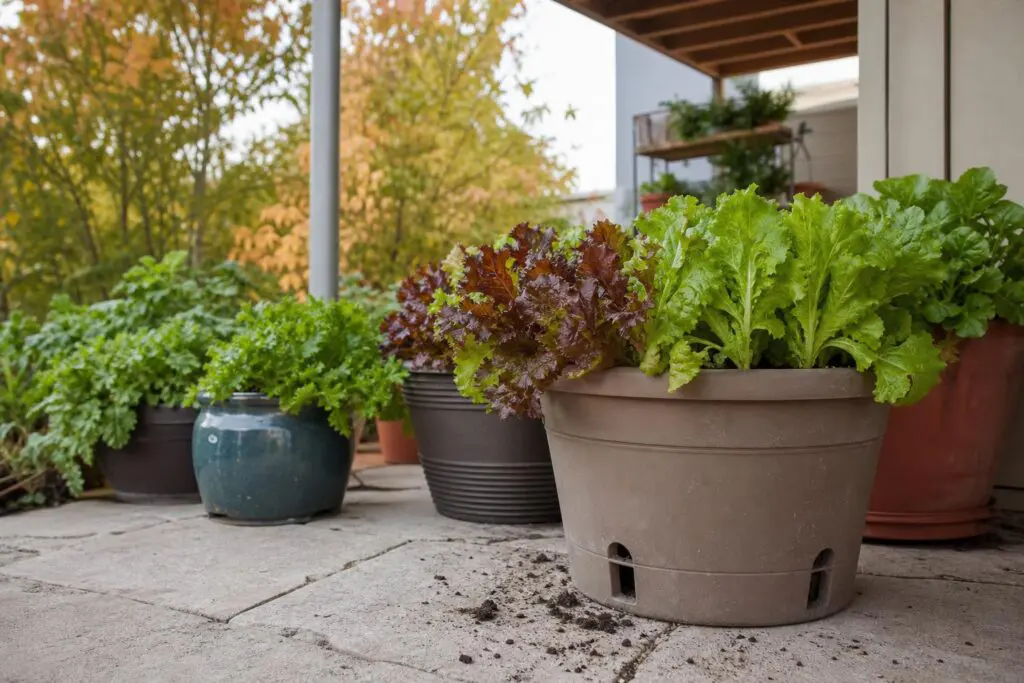
Container depth need not be substantial for shallow-rooted lettuce: Jones-Sullivan says 6 to 9 inches can work. Adequate drainage holes are essential, regardless of the vessel. A larger container gives gardeners more planting choices and is easier to maintain, so minimum depth is not the only consideration when selecting a pot.
Material also changes how a container performs. Jones-Sullivan cautions against metal when temperatures soar and notes that fabric bags dry quickly in heat, though she has found them useful in cooler months. Self-watering containers can extend the interval between watering, but she sometimes needs to release water from them during the rainy season.
Fill pots with a bagged potting soil intended for containers, rather than soil taken from the garden, Jones-Sullivan advises. The mix should have a loose structure that drains while retaining water and nutrients. She also warns against letting it dry out completely because dry potting mix can be difficult to wet again.
Check water even during rainy weather
Water management therefore involves checking both the planting’s location and its growing medium. Lewis specifically flags containers and beds under covered areas as places rainfall may not adequately reach. His checklist also calls for improving drainage around plants in low areas, a separate concern from whether a sheltered pot receives enough water.
Container care continues after planting. Jones-Sullivan notes that pots restrict root space and available water, increasing the need for watering and fertilization. She recommends a high-nitrogen, slow-release fertilizer at planting followed by liquid fertilizer during growth, while emphasizing label directions: some fertilizers are not labeled or appropriate for use in containers.
Local conditions remain central to those choices. Jones-Sullivan distinguishes ocean-influenced gardens, which may stay cool enough for lettuce year-round, from warmer inland locations. Containers offer flexibility because plants can be moved between sun and shade as conditions change. That flexibility complements, rather than replaces, attention to drainage, moisture and the needs of the selected lettuce.