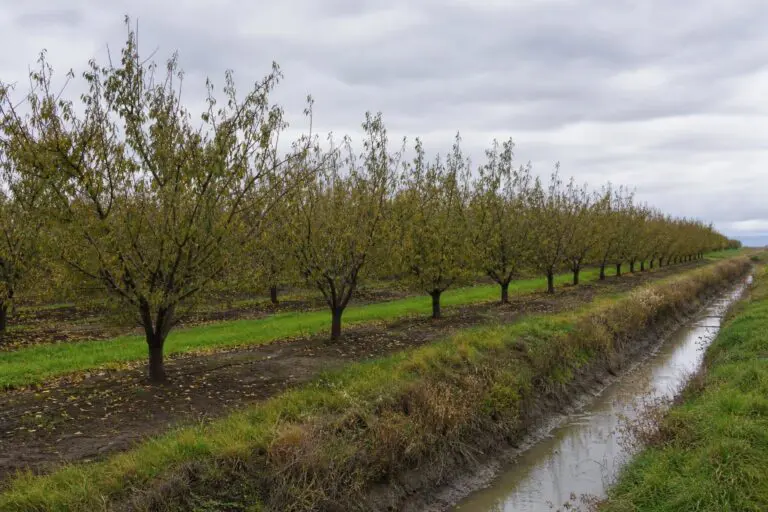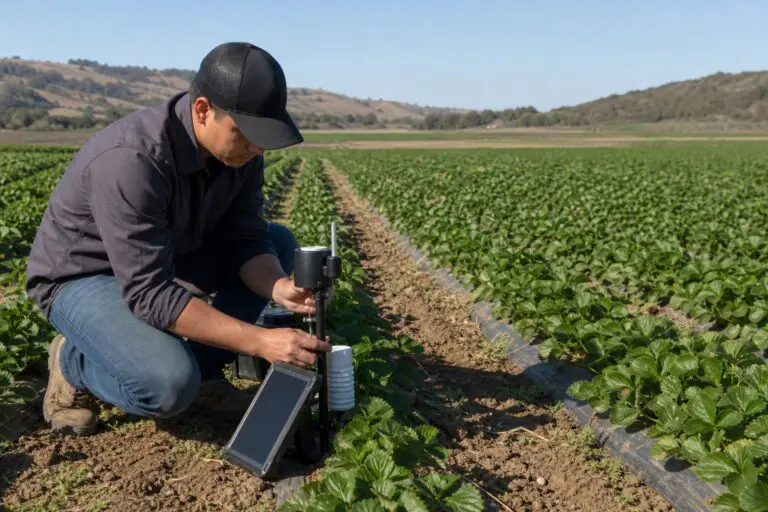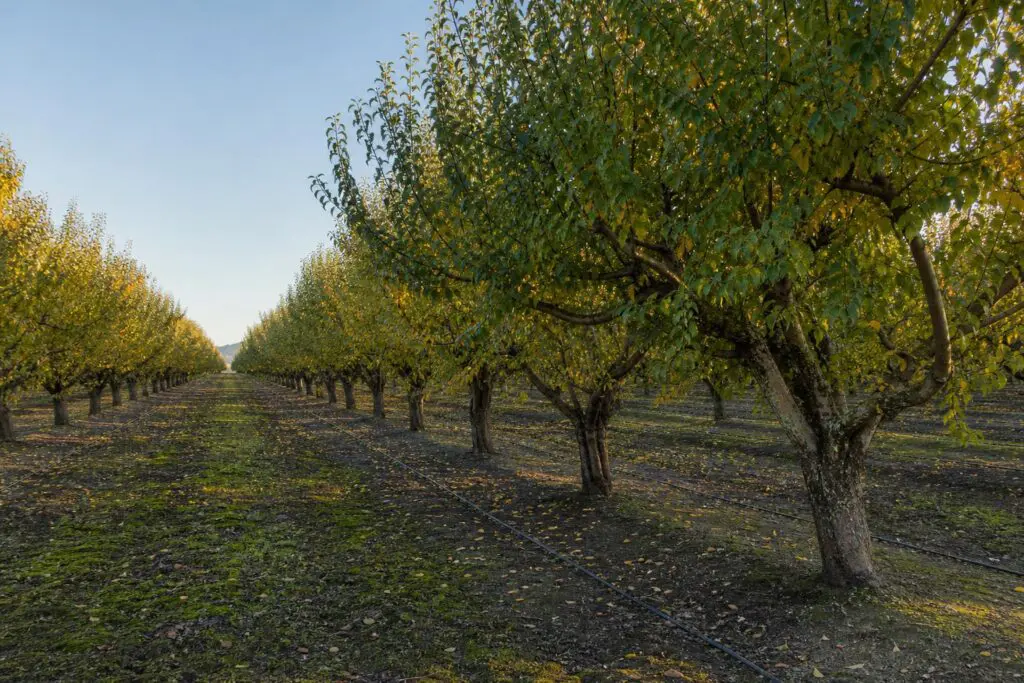
The southern Sacramento Valley crop water-use report covering October 9-15, 2026, gives prune growers a weather-based reference for fall irrigation, but not a stand-alone watering schedule. University of California Cooperative Extension guidance calls for checking those estimates against orchard conditions and tree water status while managing irrigation after harvest.
The report covers California Irrigation Management Information System stations at Woodland, Davis, Staten Island and Verona. Its estimates carry assumptions about orchard-floor vegetation and irrigation efficiency that matter when applying them to individual blocks. Understanding those assumptions helps separate estimated crop water use from the amount of water an irrigation system needs to deliver.
Postharvest management should continue until trees lose their leaves or regular autumn rain arrives, according to July 2025 guidance from UCCE advisers Luke Milliron, Curt Pierce and Franz Niederholzer. Their guidance recommends resuming full irrigation after harvest, with pressure-chamber readings helping growers assess recovery from harvest-time stress rather than relying on estimated water use alone.
Know what the ET estimate represents
UCCE’s ET interpretation guide, updated in April 2021, distinguishes measured-weather estimates from historical averages. The report’s past-week and cumulative seasonal crop evapotranspiration, or ET, figures use weather-station measurements. The next-week estimate uses a historical average, not a short-term forecast. That distinction matters when reading an outlook alongside recent water use.
The guide also assumes healthy crops whose growth is not limited by soil moisture. Bearing-orchard estimates refer to trees in their fifth leaf or older, so they should not be treated as a direct match for younger plantings. Rainfall and stored soil moisture contribute to meeting crop demand and reduce the irrigation water needed.
Orchard-floor management can change the water balance as well. The October report assumes vegetation is controlled through some combination of herbicide strips, frequent mowing or tillage, along with shading and water stress later in the season. Weekly soil-moisture losses can be as much as 25 percent higher where cover crops are managed intensively for maximum growth.
Translate water demand through the irrigation system
Turning an estimated water requirement into irrigation hours requires knowing the system’s application rate. UCCE’s guide describes estimating that rate from the number of drip emitters or microsprinklers per acre and their water output. Crop ET alone therefore cannot specify a runtime: the calculation also needs information about the equipment delivering water to the block.
System efficiency adds another consideration. The October report lists typical efficiency ranges of 80-95 percent for drip, 80-90 percent for microsprinklers, 70-85 percent for sprinklers and 50-75 percent for border-furrow irrigation. These are ranges, not measurements of a particular orchard. UCCE’s interpretation guide says more uniform application requires less water to meet crop needs.
Check postharvest recovery in the trees
For prunes, the three monitoring approaches answer different questions. ET estimates water use, soil-moisture monitoring shows water conditions in the soil, and pressure-chamber stem water potential measures the tree’s water status directly. Milliron, Pierce and Niederholzer recommend integrating all three rather than treating any one as a complete picture of irrigation need.
Their 2025 guidance recommends prompt postharvest irrigation to bring trees back to mild-to-moderate stress, corresponding to stem water potential of -12 to -16 bars. That is a postharvest recovery target, not a recommendation to maintain the stronger stress used briefly before harvest. Pressure-chamber readings provide a way to check whether trees have recovered.
The advisers warn that sustained readings of -20 bars or lower during the preharvest and postharvest period can reduce potassium uptake, encourage sunburn and Cytospora canker growth, and leave smaller fruit buds for the following year. Those risks explain why harvesting the crop does not end the need to watch tree water status.
For remaining postharvest irrigation decisions, UCCE’s guidance supports using ET as the water-use reference, accounting for soil moisture and rainfall, and checking tree response in the orchard. The stopping conditions remain leaf loss or regular autumn rain. A dated weekly estimate is one input to that decision, not a substitute for observing the block.