Walnut mold reached 27% in Chandler walnuts in Tulare County following September and October rains in 2025, according to observations described by UC plant pathologist Themis Michailides in September 2026. That localized loss highlights a quality problem that reaches beyond harvest weather: UC research shows fungi can infect walnuts as early as bloom.
The Tulare County figure describes the 2025 crop, not current statewide conditions. Michailides, based at UC’s Kearney Agricultural Research and Extension Center, also identified higher humidity in closely planted orchards and less isolation from neighboring walnut orchards as possible contributors to mold pressure. Those factors were offered as probable causes, not measured explanations for every affected block.
An April 2025 UC research account by Michailides and Victor Manuel Gabri helps explain why harvest rain is only part of the story. Their work identifies infection opportunities from flowering through hull split. It also connects mold with damaged hulls and time spent on the orchard floor, giving growers several distinct risk factors to consider.
Infection can begin at bloom
In experiments that deliberately exposed walnuts to fungi at different stages, late-April bloom inoculations produced 57% infection with Alternaria and 55% with Fusarium, significantly above water-treated controls. These are experimental infection results, not expected commercial orchard loss rates. The researchers concluded that substantial mold infection can start during bloom, with additional infection possible near and after hull split.
The researchers also examined where fungal growth began on mature kernels and cultured fungi from flower tissues. Alternaria and Fusarium were the predominant fungi recovered from the flower styles. Together with the inoculation results, those findings support an early infection pathway that would be missed by treating mold solely as a problem beginning when hulls open.
Hull appearance differed with infection timing in the UC work. Nuts infected at bloom had brown, wrinkled hulls that remained intact. Early hull-split infections were associated with partially cracked hulls, while later infections produced black, fully split hulls. The earlier-infected groups had more mold than the later-infected group, so the darkest, most open hulls did not necessarily mark the greatest mold burden.
Hull damage and pickup delays add risk
Hull damage provides another route for infection. A July 2022 UCCE article by Clarissa Reyes, Luke Milliron and Michailides described walnut blight, sunburn and insect injury as conditions that can compromise the hull. Their account noted that mold was commonly isolated from the sunburned side of developing walnuts and occurred more often in insect-infested nuts.
That UCCE guidance also identified Ivanhoe and Livermore as more susceptible to mold than some other varieties. Earlier studies associated greater mold incidence with larger nuts and larger openings at the stem end. These findings describe differences in vulnerability, rather than a single level of risk that applies equally across varieties and orchard blocks.
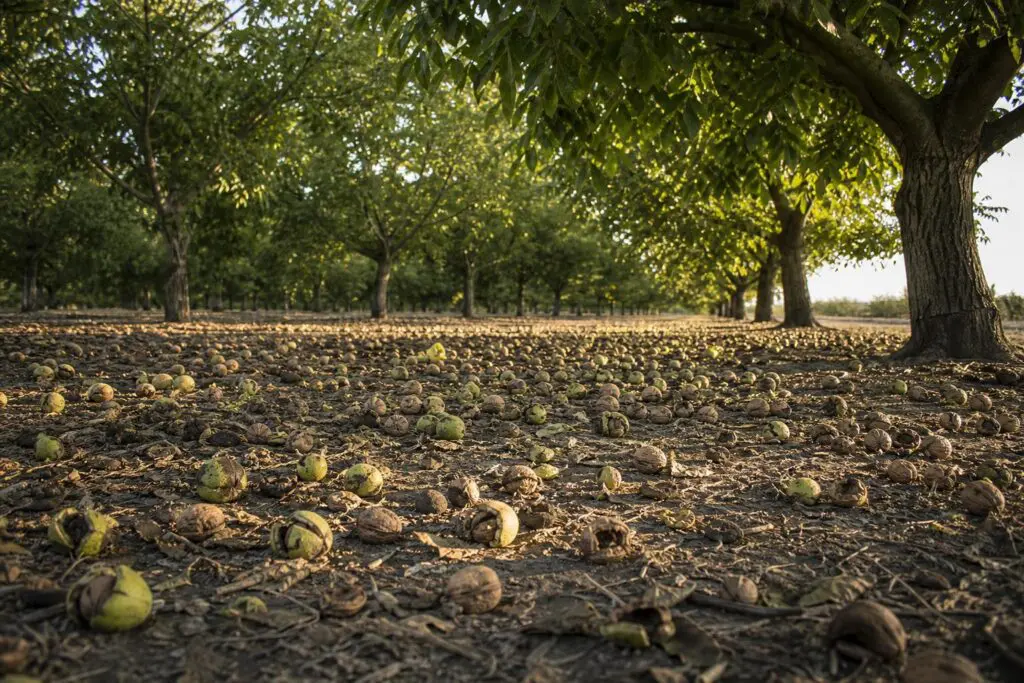
Harvest handling remains important even when infection begins earlier. UCCE cited work by advisor emeritus Bill Olson showing that mold and other quality problems increased the longer walnuts remained on trees and, especially, on the ground. The guidance identified pickup on the same day as shaking as a best practice for quality, particularly in non-Chandler blocks.
The April 2025 UC account reinforces that concern with older research: nuts left on the ground more than 24 hours had more mold. It also advises avoiding orchard puddles to limit humidity and reducing dust during bloom and hull split, when airborne Alternaria and Fusarium can reach flowers or nuts with split hulls.
Trial results depend on orchard conditions
The fungi involved can differ among orchards. Michailides and Gabri identify Fusarium and Alternaria as predominant causes in recent years, while Botryosphaeria and Phomopsis can also cause kernel mold where their canker and blight diseases occur. That distinction matters when interpreting research results from orchards with very different disease pressure.
For example, their 2025 account describes a 2024 trial in a sprinkler-irrigated Chandler orchard with severe Botryosphaeria canker and blight. More than 75% of moldy nuts yielded Botryosphaeria species, and experimental bloom treatments reduced blighted, moldy nuts by 43% to 73%. Those results describe a specific disease setting, not a universal treatment response.
Another trial, conducted in 2023 in a flood-irrigated Chandler orchard, found reductions of 40% to 55% across tested fungicide programs, without a significant difference between one and two sprays. The studies are refining the understanding of infection and control, while the cultural guidance remains concrete: preserve hull integrity and minimize the time shaken nuts wait for pickup.