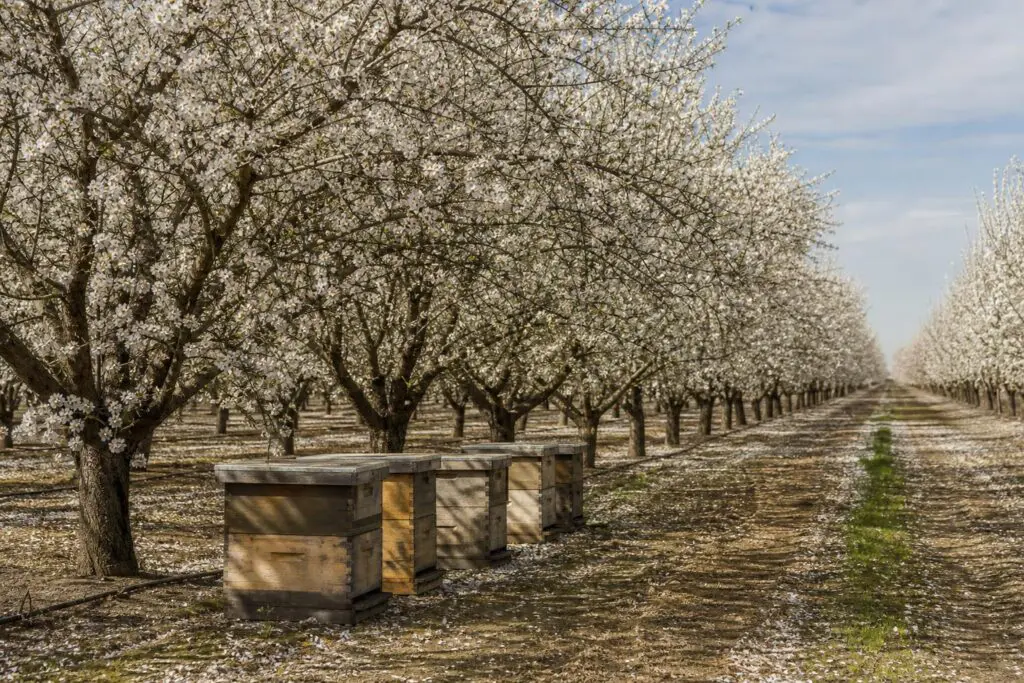
Independence almond trees produced more nuts and higher yields when honey bees could reach their flowers, according to an Almond Board of California account of research conducted in 2020 and 2021. But the study leaves a narrower question unresolved for growers paying for pollination: how many rented hives deliver the best return in a self-fertile orchard?
The distinction matters because two results address different decisions. Excluding bees reduced production compared with leaving trees accessible to them. Raising the stocking rate from one hive per acre to two, however, did not significantly increase flower visitation. That second finding is not a demonstration that the two rates produce equal yields or equal profits.
Elina Niño, a University of California, Davis extension specialist in apiculture, led the work with collaborators including USDA Agricultural Research Service researcher Arathi Seshadri. Supported by the Almond Board, the project examined bee access, stocking rates, nut set, yield and kernel characteristics specifically in Independence, rather than testing self-fertile almonds as a single interchangeable group.
Bee exclusion and zero rentals are different tests
In the first year, researchers enclosed some trees in cages to keep bees out completely and left other trees open to pollination. That comparison tested the value of bee access directly. Trees accessible to honey bees had significantly greater nut set, followed at harvest by higher yields and greater wet and dry weights.
Researchers expanded the design in the second year. Alongside the other treatments, they included trees under shade cloth that remained open on all four sides. They also compared orchard stocking treatments of zero, one and two hives per acre, allowing them to examine bee activity under different levels of rented-hive provision.
The zero-hive treatment was not bee-free. Researchers expected bees to arrive from neighboring conventional almond orchards and estimated that background presence at the equivalent of half a hive per acre. The distinction separates an orchard without rented colonies from an experiment that physically excludes pollinators. Those conditions answer different questions.
Technicians counted bees during five-minute observation periods in the morning and evening, then averaged the counts. They recorded fewer flower visitors in the no-hive treatment despite the background bee presence. Bee activity increased between zero rented hives and one hive per acre, but the increase from one to two hives was not statistically significant.
Visits, kernel size and yield tell different stories
Flower visits provide a measure of bee activity, not a complete accounting of harvest value. The reported comparison between one and two hives therefore cannot, by itself, establish that reducing rentals preserves production. Nor does a statistically nonsignificant visitation difference identify the most profitable stocking rate. That requires connecting pollination costs with the resulting crop.
The kernel measurements add another distinction. Researchers evaluated samples of 100 kernels from caged and uncaged trees. Although bee-accessible trees produced more nuts overall, their average kernel mass was slightly lower. Niño attributed that pattern to trees distributing resources among a larger number of nuts, which can leave individual kernels smaller.
That result does not reverse the reported yield benefit from bee access. It shows why kernel size and total production should not be treated as the same outcome. In this experiment, more nuts and higher overall yield occurred alongside a modest reduction in average kernel mass.
The economic question remains rate-specific
Pollination's cost side also extends beyond placing colonies in an orchard. In a separate university analysis published October 15, 2026, University of Illinois researchers Brittney Goodrich and Allison Altschuler described expenses for supplemental food, replacement queens, colony management, hauling and holding yards. Their representative migratory-operation budget illustrates the work behind supplying colonies, rather than measuring an Independence orchard's return from a particular stocking rate.
The two studies thus address different parts of the decision. The Independence experiment tests biological responses to bee access and stocking treatments. The university budget accounts for the resources used to supply pollination services. Neither establishes a universal profitable hive rate for self-fertile almonds.
Niño described the Independence work as a smaller-scale study and called for additional research to strengthen grower guidelines, particularly for newer self-fertile varieties. Extending its conclusions to those varieties remains an assumption, not a result of this experiment. The open question is more specific than whether bees help: how much additional production different stocking rates deliver, and whether that production pays for the additional rentals.