A Solano County gardener has reported two successful Blue Java banana harvests after a project that began in 2022, with wind protection emerging as a central lesson. The backyard experience, described in a November 6 follow-up on UC Agriculture and Natural Resources’ Under the Solano Sun blog, offers a practical distinction for home gardeners: growing a large banana plant is not the same as bringing its fruit to harvest.
The follow-up describes wind tearing leaves, damaging blossoms and pulling away developing bananas. Its strongest lesson concerns the planting location, not simply the choice of a banana advertised as cold tolerant. These are observations from one garden, rather than results from a cultivar trial, but university guidance helps explain why shelter and winter exposure can affect the outcome.
Three years to developing fruit
Vincent Hughes documented the project’s beginnings in a July 29, 2025, article. His Blue Java arrived in a five-gallon pot in May 2022. He kept it in the container through the following winter while choosing a permanent location, allowing him to move it indoors when conditions appeared unsuitable.
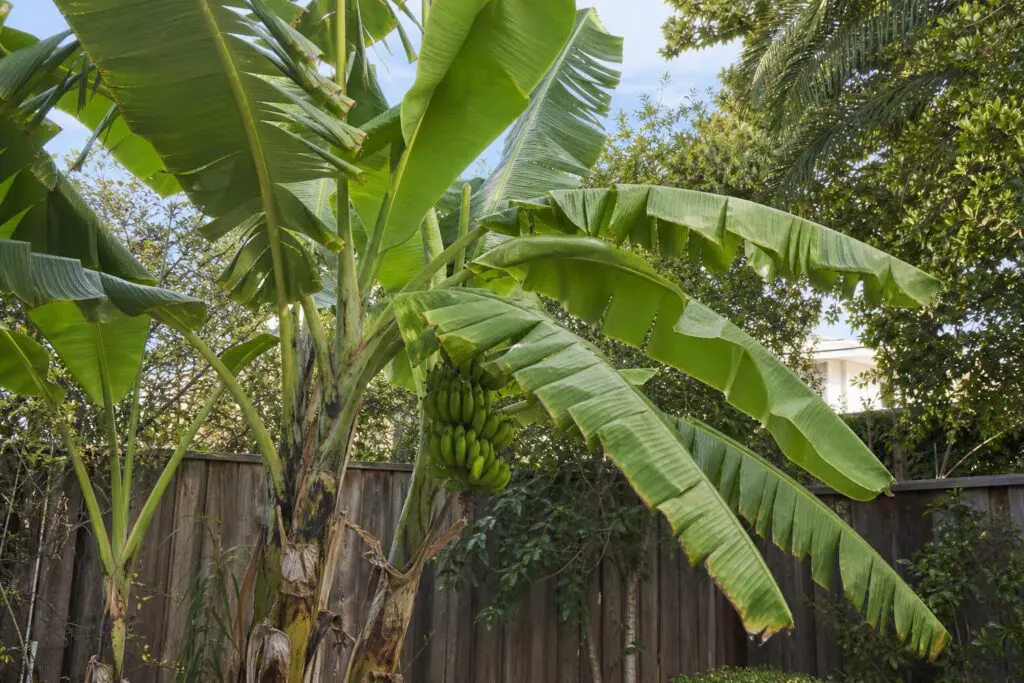
In March 2023, Hughes planted it along his backyard’s south fence. He described a location with morning sunlight, afternoon shade from a nearby plum tree and some protection from strong winds. New shoots appeared that spring, and he finished 2023 with three growing banana stems. That vigorous growth raised hopes for fruit the next year.
But 2024 brought another shoot, not bananas. Blossoms finally appeared in April 2025, with fruit developing by June. The July account still described unharvested bananas. The later follow-up identifies the first harvest as occurring in 2025 and reports two successful harvests overall. Its November 2026 publication date is not a harvest date. The sequence matters because Hughes waited about three years from purchasing the plant to seeing fruit develop.
Although commonly called trees, bananas are herbaceous plants. Jonathan H. Crane and Carlos F. Balerdi explain in their UF/IFAS home-landscape guide that the trunklike structure is a pseudostem made of tightly packed leaf sheaths. An underground rhizome produces roots and new shoots. That structure helps explain how a planting can expand even while a gardener waits for its first crop.
Survival is not a harvest
The Florida guide identifies wind as a frequent constraint in subtropical banana growing. Persistent wind can shred and dry leaves and distort the plant’s crown. That background is consistent with the Solano follow-up’s account of damaged leaves and reproductive growth. For a gardener seeking fruit rather than foliage alone, shelter must protect the plant through flowering and fruit development, not just while it is small.
Cold creates a separate hurdle. Crane and Balerdi describe chilling injury above freezing, including failure of the flowering stalk or fruit bunch to emerge, misshapen fruit and increased rotting. Freezing can damage leaves, pseudostems and fruit. Their guide says temperatures below 28 degrees Fahrenheit may kill plants to the ground, although shoots usually return from the underground rhizome when warmth returns.
Those figures are general guidance written for Florida, not verified Blue Java damage thresholds for Solano County. The useful distinction is between survival and production: regrowth from underground does not mean an existing fruiting stem or bunch escaped injury. A plant’s ability to return after cold weather therefore does not, by itself, predict a dependable harvest.
Shelter needs an outlet for cold air
California frost guidance adds another consideration to choosing a sheltered spot. In a University of California publication copyrighted 2000, Extension biometeorologist Richard L. Snyder explains that dense cold air moves downhill and collects in low places. Buildings, fences and vegetation can change its path, sometimes increasing freeze exposure when they obstruct drainage and direct cold air into a planting.
Wind shelter and cold-air drainage therefore need to be considered together. A fence that reduces wind exposure does not automatically make every nearby position a favorable winter site. Snyder’s guidance emphasizes the importance of location and the movement of cold air, providing a reason to look beyond a cultivar’s hardiness description when evaluating a backyard planting.
Water drainage also deserves attention. The UF/IFAS guide says bananas are not flood tolerant and identifies stunting, yellowing leaves and reduced yields as symptoms associated with continuously wet soil. Hughes likewise emphasized well-drained soil in his original account. A location that offers wind protection still needs suitable root-zone conditions; shelter alone cannot address excess water.
For gardeners considering a similar project, the documented timeline is a useful starting point: a container-grown beginning, a protected planting location, expanding shoots and a longer-than-expected wait for fruit. The next milestone is not simply another new shoot. It is keeping flowering and developing fruit intact through the conditions that follow.