California scrub oak belongs in a well-drained landscape, not one kept wet by frequent watering. A November 6 UC Master Gardener post identifies native companion plants for this evergreen shrub and emphasizes avoiding overwatering once it is established. For gardeners planning around an oak, drainage and compatible water needs come before filling the available space.
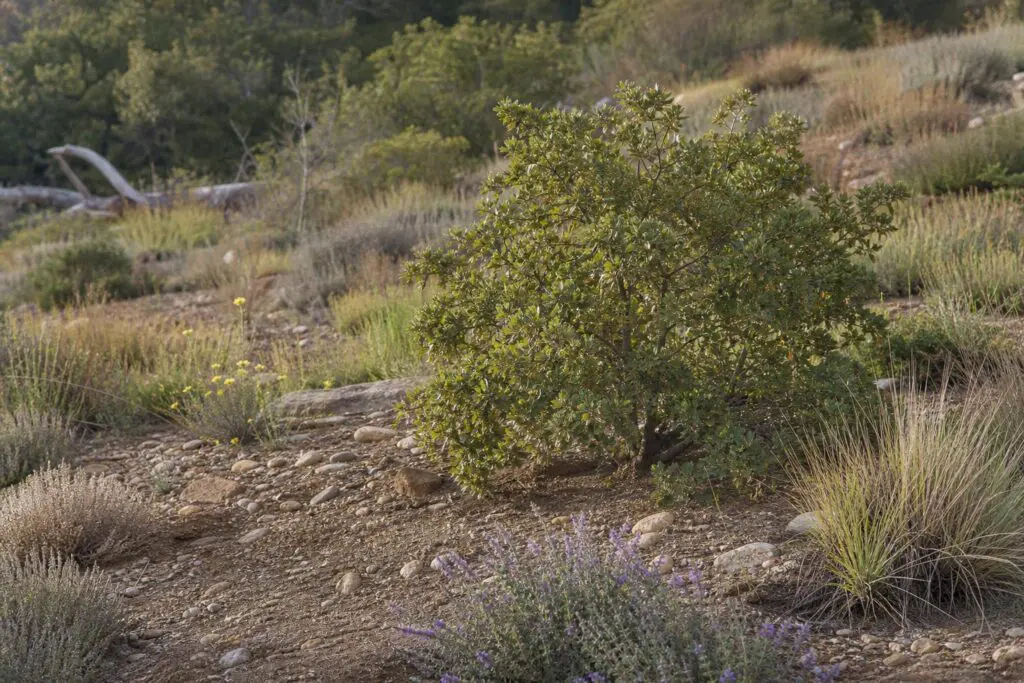
The post describes California scrub oak, Quercus berberidifolia, as a small native oak associated with chaparral and found in the hills of Solano and Yolo counties. It can suit a small garden, hedge or low windbreak. Unlike a large shade tree, this shrub-sized oak offers an option for smaller landscape spaces.
Scrub oak tolerates drought, rocky ground and either full sun or partial shade, according to the post. Its evergreen foliage also provides winter food and shelter for wildlife when deciduous oaks have lost their leaves. Those characteristics give gardeners reasons to retain it as a landscape feature rather than treat it simply as a backdrop.
Match companions to the planting site
Start companion selection with the conditions in each planting area. The scrub-oak post identifies good drainage as essential. Older UC Cooperative Extension guidance by John Lichter and Ellen Zagory recommends matching plants to climate, light, soil texture, drainage and eventual size. Their publication addresses tree-sized Central Valley oaks, rather than scrub oak specifically.
For dry shade, the new post points to native perennial grasses, including California fescue and Torrey’s melicgrass. Its bulb choices include golden globe lily and Ithuriel’s spear. These form one part of a broader companion list organized by plant form, giving gardeners alternatives to filling every opening with shrubs.
Other listed companions include California poppy, California aster and native clovers, along with yarrows, buckwheats, phacelias and woolly bluecurls. Taller choices include toyon, chamise, ceanothus and manzanita. California fuchsia, hummingbird sage and coyote mint appear among spreading groundcovers. Use these as candidates to match to the site, not as interchangeable choices for every exposure.
A planting sketch can help sort those choices. Lichter and Zagory’s guidance, revised in July 2003, recommends marking oak trunks, canopy edges, existing plants and structures, then identifying full sun, partial shade, full shade and morning-sun areas. It also calls for considering whether plants at maturity will interfere with canopies, views or structures.
Protect mature oak roots during installation
Where a landscape includes mature tree-sized oaks, root protection adds another constraint. Lichter and Zagory recommend sparse accent plantings rather than dense beds that compete for water and nutrients. Their advice to avoid planting beneath the canopy, or at least within 10 feet of a mature trunk, concerns those trees, not a verified spacing rule for scrub oak.
Installation can damage mature oak roots even before irrigation begins. The same publication warns against injury from digging equipment, trenching, grading and soil compaction. It recommends keeping equipment traffic and storage out of the root zone, digging planting holes by hand where possible, and ensuring that landscape drainage does not collect around the trunk.
Establishing new companion plants also requires a different approach from maintaining established ones. Lichter and Zagory recommend applying only enough water for establishment, over as small an area as possible. Drip or microsprinkler systems can serve that purpose, but their guidance cautions against operating them in ways that leave soil saturated for long periods.
Separate drought support from routine watering
UC Master Gardener Kim Wilson’s oak-care guidance, revised in 2019, explains the disease concern: frequent summer watering creates warm, wet conditions favorable to root pathogens. For established urban oak trees, Wilson describes little or no supplemental irrigation under ordinary conditions, while allowing carefully planned, slow, deep watering during drought following dry winters.
That drought exception is not a routine watering schedule for scrub oak or its companions. Wilson’s guidance concerns tree-sized oaks, while the scrub-oak post specifically cautions against overwatering established shrubs. For a mixed oak landscape, keep the distinction between establishment water, occasional drought support for mature trees and frequent summer irrigation central to the planting plan.