Orchard growers still considering a winter cover crop have a November planting opportunity, but seed selection needs to account for cooling soils and wet conditions. In guidance published Nov. 6, UC Cooperative Extension specialty crops advisor Kamyar Aram recommends considering grasses, either alone or in a mix, while planning how to manage the resulting vegetation in spring.
Aram reports repeated success with cover crops seeded during the first 10 days of November in the relatively mild Mt. Diablo region. Without irrigation, even earlier-seeded cover crops often wait for November rain to germinate. That local experience supports a late planting option, not a guarantee that the same timing will produce a strong stand throughout California.
Grass establishment comes with a competition trade-off
Cool temperatures and waterlogging can make establishment harder for legumes and brassicas, Aram writes. Grasses can rapidly take up nitrogen remaining in the soil, help keep it from leaching and improve traction in orchard alleys. They also regrow after mowing, allowing growers to reduce vegetation height while retaining living cover if rain continues late in the season.
The trade-off is competition within the seed mix. Too much grass can crowd out other cover-crop species, according to Aram. Larger-seeded legumes, including faba beans and field peas, may establish better in cool, wet conditions than smaller-seeded legumes such as vetch. For predominantly mustard or small-seeded legume plantings, he says earlier sowing and establishment irrigation, where available, may improve the stand.
What three walnut trial seasons showed
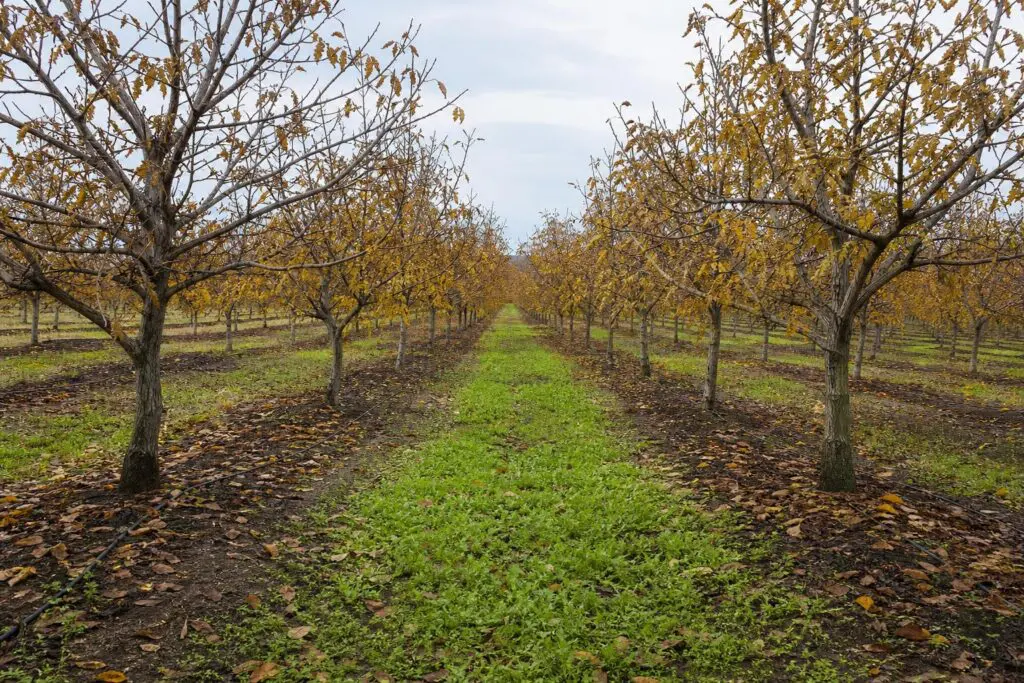
A three-season walnut trial in eastern Contra Costa County illustrates why keeping legumes in the mix can matter. Aram’s report, published in October 2025, compared winter triticale, a mustard-and-radish blend, and a custom mixture of grasses, mustards and legumes. The legumes included bell beans, common vetch and field peas.
Researchers drilled those treatments in early November 2022, 2023 and 2024. The cover crops relied entirely on rainfall for germination and growth. The trial included unplanted comparison rows, and the orchard used solid-set sprinklers that wetted the entire orchard floor during irrigation. Those conditions are important context for applying the findings to other orchards.
In spring sampling just before April mowing, the legume-containing mixture consistently produced more aboveground vegetation than either triticale or the mustard blend. In 2024 and 2025, it produced four to five times as much aboveground biomass as the other treatments. Both triticale and, especially, the mustard blend grew poorly during those two seasons.
The mixed cover crop also contained more nitrogen in chopped vegetation sampled after mowing in April 2024 and 2025. Its nitrogen advantage held even relative to the amount of biomass produced. Aram observed strong nodulation on the legumes’ roots, but described the possible role of added nitrogen in driving growth differences as a question rather than a proven explanation.
Soil sampling supplied another distinction. Before spring mowing, soil nitrogen levels were low and did not differ among treatments. By July, the mixed-cover plots had higher soil nitrogen than the other treatments, suggesting a growing-season contribution from the cover crop. The trial did not establish a fertilizer replacement rate, and soil organic matter did not differ among treatments, including the unplanted comparison.
Plan spring mowing and termination
More biomass also means more vegetation to manage. Aram’s November guidance emphasizes timely termination and attention to cover-crop water use. Persistent late rain can delay access for termination; a well-timed high mowing during a dry interval may help control growth. Mowing does not necessarily end the cover crop, particularly where grasses can regrow.
Residue behavior depends on orchard conditions. In Aram’s sprinkler-irrigated trials, cover-crop mulch left after April mowing had largely decomposed by August. He reports no nut-harvest interference from residue over four years of that experience. That observation is separate from the three-season dataset summarized in 2025 and should not be treated as another year of measured biomass results.
The walnut trial’s strongest measured result was the diverse mix’s biomass advantage at that site. Aram cautioned that other locations or seasons could produce different outcomes, and that triticale and mustards might perform better where nitrogen is less limiting. Although improving infiltration was an original trial goal, his measurements suggested only possible improvement, not a confirmed water-saving benefit.