University of California researchers are testing anaerobic soil disinfestation at a northern San Diego County strawberry farm to learn whether the biological treatment works in its stony, clayey soil. The trial could help small-scale growers assess an alternative to soil fumigation, but local yield and disease results are not expected until late spring or early summer 2027.
UC described the project in a Nov. 6 announcement. Grower Kenny Fietz sought scientific help after noticing a gradual production decline following roughly 13 years of growing strawberries. The trial evaluates a possible soil-management tool at Kenny’s Strawberry Farm; it has not yet confirmed improved yields or reduced soilborne pathogens there.
The project pairs Ana María Pastrana, a UC Cooperative Extension plant pathology advisor serving Imperial, Riverside and San Diego counties, with Joji Muramoto, a UC Cooperative Extension organic agriculture specialist based at UC Santa Cruz. Their central question is whether a technique used elsewhere in California will perform under this farm’s particular conditions.
Creating a temporary low-oxygen soil environment
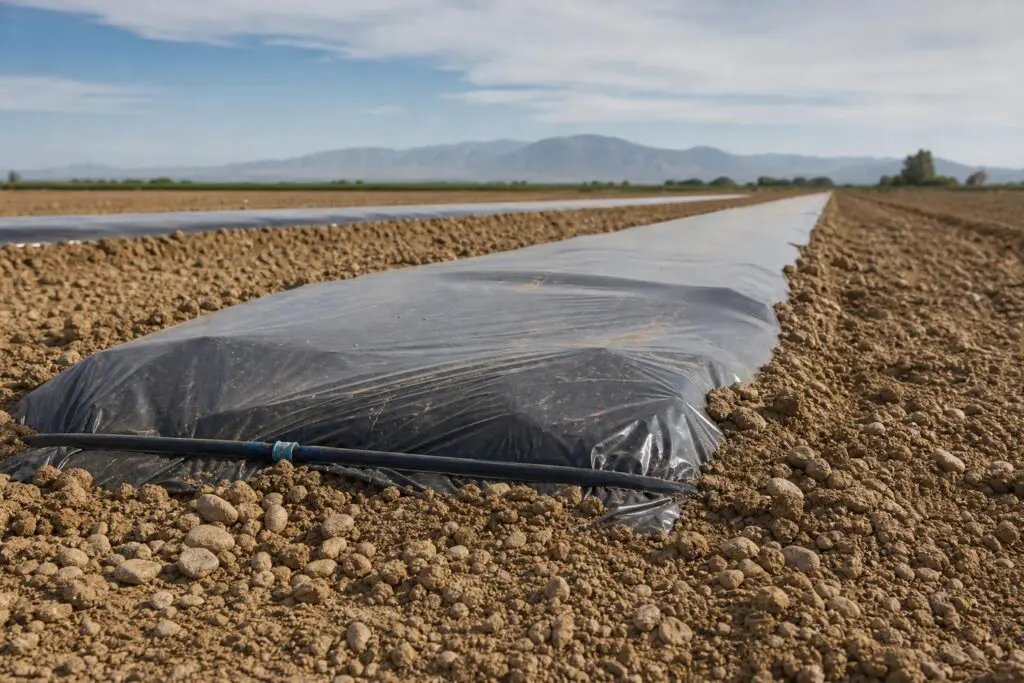
For this trial, researchers incorporated wheat middlings, a wheat-milling byproduct, into the soil. They installed drip irrigation and covered the treated ground with impermeable plastic film. The treatment was designed to remain covered for about four weeks, with sensors tracking soil moisture, temperature and conditions associated with oxygen availability.
The added carbon feeds soil microorganisms. As microbial activity uses up available oxygen beneath the film, the soil develops anaerobic, or low-oxygen, conditions. Muramoto explained that the resulting fermentation produces organic acids and other compounds that can suppress certain soilborne pathogens. The approach was developed as an alternative to chemical soil fumigation.
Pastrana emphasized that the aim is not to sterilize the ground. Instead, the treatment temporarily changes the soil environment and its microbial community. That distinction matters to the research question: scientists are testing whether those changes can suppress disease organisms under local conditions, not whether the treatment eliminates everything living in the soil.
Results from other soils are background, not a forecast
Earlier UC guidance describes consistent suppression of Verticillium dahliae and Macrophomina phaseolina with rice bran or wheat middlings in sandy to loamy soils. It also reports yields generally comparable to those in fumigated soils. Those findings provide background for the San Diego County work, not a forecast of its results.
The soil difference is precisely why Pastrana says the local test is needed. “We want to see whether it works here, under these conditions, in this stony, clayey soil,” she said in UC’s announcement. Researchers have not yet confirmed whether treatment at this location will deliver either pathogen suppression or a production benefit.
Temperature adds another variable. In research materials dated May 23, 2024, Muramoto explained that both the degree of anaerobic conditions and soil temperature influence ASD performance. Those materials report that organic acid production increases as soil temperature rises, and describe different environmental requirements for suppressing different strawberry pathogens.
Disease, timing and costs shape the test
UC’s ASD guidance also flags a potential downside: some disease organisms can benefit from the added carbon. It warns that rice bran or wheat middlings can worsen Fusarium disease, particularly under cooler fall soil conditions. That caution limits any broad claim that the same biological treatment will suppress every soilborne disease.
Timing therefore involves more than keeping soil under plastic for a set number of weeks. Muramoto said in the new announcement that the target pathogen can affect whether treatment needs to occur in midsummer or fall. The San Diego County trial’s temperature and oxygen-related monitoring will document conditions during its approximately four-week treatment.
Materials are another practical consideration. Muramoto noted that ASD requires a carbon source and plastic film, adding production costs. For Fietz and other growers watching the project, the next milestone is the expected 2027 findings on local performance. Until then, the farm remains a test of suitability for this soil, rather than a demonstrated success.