UC Davis researchers are investigating invasive Houdini flies and possible disease movement among bees, two concerns for the blue orchard bee used in almond and other spring-blooming orchards. Their work includes a three-year monitoring effort that found increasing fly parasitism in the Pacific Northwest, alongside ongoing research into whether different bee species can harbor and share pathogens.
The research concerns a native pollinator with a different nesting system from honey bees. Blue orchard bees, Osmia lignaria, live as solitary bees rather than in colonies. Females build their own nests, but they can nest close together in managed blocks. That combination makes the individual nest a useful place to examine threats to future pollinator populations.
A solitary bee managed in nest groups
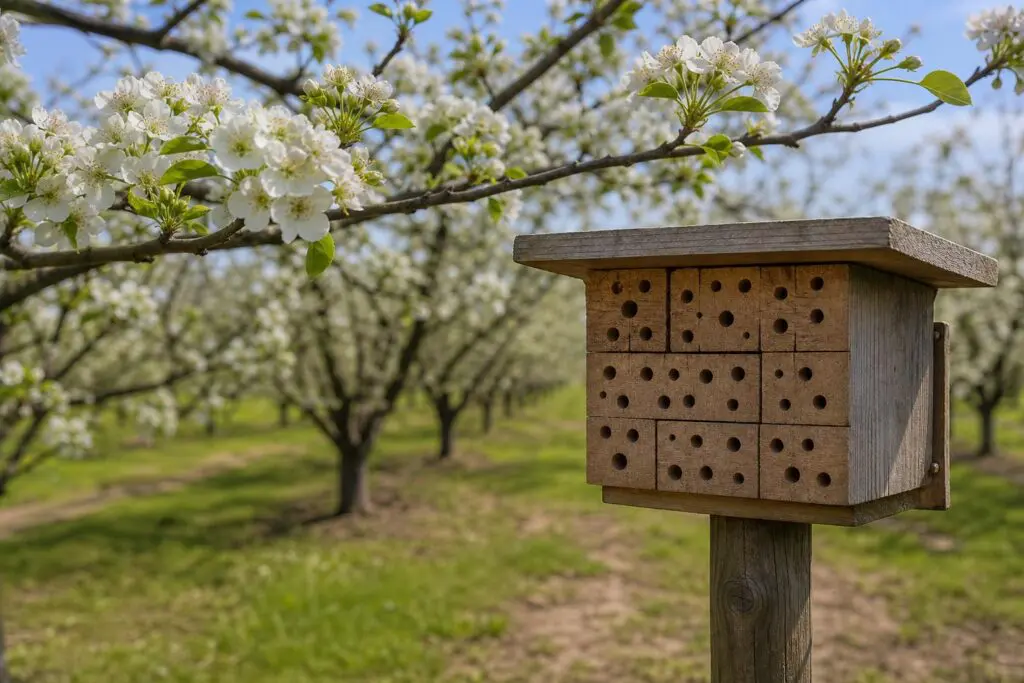
Research entomologist Theresa Pitts-Singer described that biology in a March 2021 fact sheet published by Utah State University Extension and the Utah Plant Pest Diagnostic Laboratory. Females use existing cavities, including holes in wood. They also accept artificial tunnels in wooden blocks, hollow reeds and cardboard tubes, allowing growers to provide nesting sites around orchards during bloom.
The nesting season produces the following spring’s bees. Offspring develop into adults during summer, spend winter inside cocoons and emerge as temperatures warm in early spring, Pitts-Singer explained. Under managed conditions, temperature control can adjust emergence to match orchard bloom. The bees’ role in pollination therefore extends beyond spring flower visits to the survival of developing offspring in nests.
Houdini fly monitoring shows a regional increase
Houdini flies, Cacoxenus indagator, target those nests. According to UC Agriculture and Natural Resources, adult flies lay eggs in pollen stored in newly built mason bee nests. Their larvae feed mainly on that pollen and may also eat bee larvae. The fly is native to central and southern Europe and has been introduced to the United States.
In a 2025 research account published by UC ANR, UC Davis doctoral candidate Abigail Lehner reported monitoring blue orchard bee nest blocks in Washington, Oregon and California over three years. She said Houdini fly parasitism increased significantly over that period in the Pacific Northwest. The finding describes a regional trend, not a demonstrated increase across all three states.
For California orchard readers, that geographic distinction matters: California nests were included in the monitoring, but the reported increase was specific to the Pacific Northwest. Lehner described the work as a way to understand patterns over time and the fly’s longer-term effects, with the goal of informing commercial management and conservation of cavity-nesting bees.
Disease spillover remains a research question
Disease research asks a separate question: which pathogens infect blue orchard bees, and whether those pathogens can move between bee species. UC ANR identifies UC Davis doctoral candidate Alexia Martin as investigating pathogen spillover between mason bees and honey bees. Her work also considers non-native horn-face bees, Osmia cornifrons, as possible disease reservoirs for native blue orchard bees.
Those are research questions, not confirmation that horn-face bees transmit disease to blue orchard bees. In the 2025 UC ANR account, Martin described work on chalkbrood strains in deceased blue orchard bee larvae across their western range. She was investigating differences among strains and how those differences affect infection, including which strains can infect blue orchard bees.
Martin emphasized that infection in solitary bees has received less study than disease in commercially managed social bees. Her project combines laboratory and sequence-based approaches to examine chalkbrood. Identifying a pathogen in a bee and determining whether it can infect another host are distinct questions, both central to understanding the potential for disease spillover.
The bees’ nesting requirements provide another part of the health picture. Pitts-Singer’s 2021 explanation identifies flowers for nectar and pollen, plus moist soil for nest partitions and plugs, as essential resources. Spring adults live about four to six weeks, a short period in which females must gather food and construct nests that support the next generation.
That annual cycle connects the research directly to orchard pollination. Blue orchard bees are used commercially, particularly in almonds and early-blooming fruit trees, according to UC ANR. Fly monitoring addresses what happens inside their nests, while Martin’s disease work examines infection and potential host relationships. Both focus on bees whose offspring must survive well beyond the orchard’s bloom period.