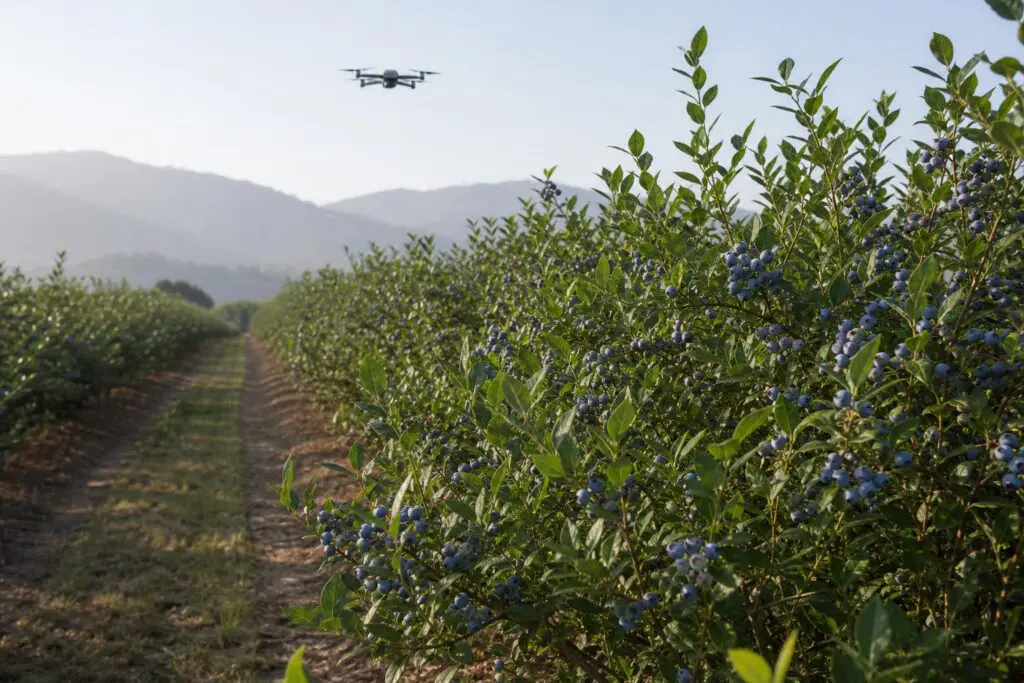
Drones moved birds in most encounters during a California blueberry study, but getting them to leave the field proved harder. Preliminary results from UC Cooperative Extension Farm Advisor Raymond Mireles distinguish an immediate scare response from the more demanding goal of protecting marketable fruit. Further research is planned for 2027.
Across 27 drone-flight observations, birds flushed and moved a short distance in 15 encounters. Eight encounters ended in apparent abandonment of the area. Mireles reported displacement in 85% of encounters, while only 30% resulted in apparent field departure. Those measures describe bird responses, not a demonstrated reduction in crop damage or a financial return.
The distinction matters because a bird moving within a planting is not the same as a bird leaving it. Mireles described the first year as establishing the feasibility of drone deterrence. His next research phase will examine operating conditions that produce reliable, sustained displacement of key blueberry-feeding species, along with crop protection and economic feasibility.
Monitoring identifies species and activity windows
The study also used autonomous audio recorders at three blueberry locations in Delano and Kingsburg. Monitoring ran from April 14 through June 16, covering ripening, harvest and postharvest conditions. Researchers used the recordings to identify birds and their activity patterns, grouping detections into berry feeders, opportunistic feeders and insectivores.
Among the berry feeders, cedar waxwings and house finches were detected most frequently. European starlings and American robins were also identified. Morning bird detections significantly exceeded evening detections at every location, with activity peaking from 7 to 8 a.m. These recordings describe when birds were detected, rather than measuring how much fruit they damaged.
Bird responses to the drone also differed by species. Cedar waxwings were frequently displaced, while house finches often required a closer approach before moving. The trial used a DJI Mavic drone and recorded responses ranging from no response or alertness to short movements or abandonment. The results do not establish a single effective approach for all birds.
Bird behavior shapes the damage
Species differences are also central to Oregon State University Extension’s broader guidance on nonlethal bird deterrence. Its publication, issued in September 2020 and reviewed in 2024, explains that flock size, feeding habits, seasonal patterns and surrounding habitat affect damage. That guidance provides background for interpreting the California work, not independent confirmation of its drone results.
Where birds feed can differ even within a blueberry bush. Oregon State Extension notes that robins tend to feed from the ground on lower berries, while starlings tend to land in the upper canopy. Some birds consume entire fruit; others puncture it. Identifying the birds present therefore adds useful context beyond simply counting activity.
Losses also extend beyond fruit eaten outright. According to the Extension authors, birds can knock berries to the ground, and partially damaged fruit can become more vulnerable to disease and insect pests. Pickers must avoid damaged berries, adding harvest costs. Those effects make marketable yield and sorting labor relevant measures when evaluating deterrent performance.
Testing the economic case
Oregon State Extension advises weighing a deterrent’s initial investment against the scale of crop losses, including the labor needed to implement control and grade out damaged fruit. Its guidance favors a combination of methods rather than one simple solution. That broader cost framework is separate from the California trial’s preliminary measures of bird movement.
Mireles identified cost and declining effectiveness as challenges with existing tools. Netting carries high labor costs, while birds can become accustomed to auditory scare devices. The drone research explores another approach, but its early results do not yet show whether it can provide sufficient crop protection to justify its operating costs.
The planned 2027 work will focus on which drone operating conditions keep key blueberry-feeding birds displaced reliably and for longer periods. Crop-protection and economic evaluations are also planned. For now, the clearest result is a difference in response: birds often moved, but substantially fewer encounters ended with apparent departure from the field.