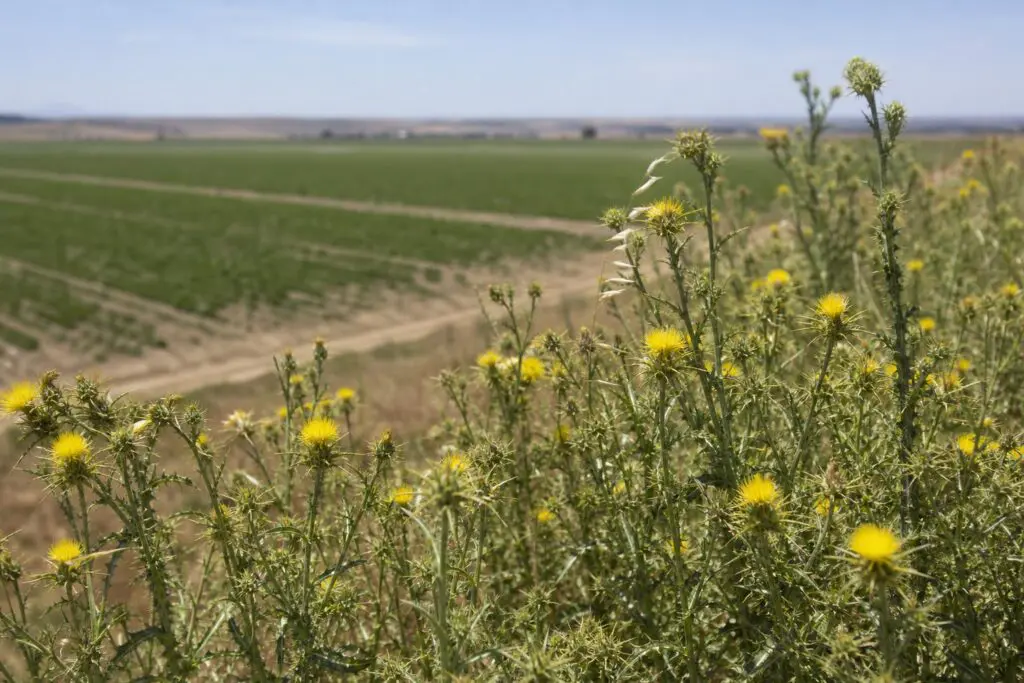
Efforts to establish a weevil that attacks yellow starthistle are continuing in California, according to UC Agriculture and Natural Resources. The insect illustrates both the promise and the patience involved in biological control: researchers seek natural enemies that can suppress established invasive pests over time, rather than eliminate them in a single intervention.
The rosette weevil, Ceratapion basicorne, received approval for release in California in 2019. UC ANR describes the establishment work in an October educational series, not as a newly approved release. Researchers with the U.S. Department of Agriculture and California Department of Food and Agriculture have worked to identify, release and monitor several natural enemies of yellow starthistle.
Suppression, not eradication
Biological control uses natural enemies, including predators, parasites and pathogens, to reduce pest populations. It can happen naturally or through intentional releases. For invasive species already too widespread to eradicate, UC ANR describes the goal as lasting suppression. Ideally, introduced natural enemies establish populations that sustain themselves without repeated human intervention.
That approach addresses one reason invasive species can spread quickly: outside their native range, they may escape the natural enemies with which they evolved. Introducing an appropriate enemy can help reduce their impacts. Successful programs can also lower pest-management costs and pesticide use, according to UC ANR, although those benefits depend on the program’s results.
Yellow starthistle shows how a carefully chosen insect can attack a weed from within. Adult rosette weevils feed on its leaves and lay eggs inside them. The larvae then tunnel through the plant toward the upper root. Their feeding can seriously weaken or kill the plant, particularly when several weevils infest it.
Research comes before release
Finding an insect that attacks a pest is only the start. UC ANR says importing new biological-control species requires international cooperation and research by legally permitted state, federal and university scientists. Researchers identify natural enemies attacking invasive pests in the wild, then select candidates for further evaluation under release regulations and protocols.
Before approval, candidate agents undergo testing for their ability to control the target pest and for risks to other California species. That research generally takes years and occurs in quarantine facilities designed to contain the organisms. Monitoring continues after release to evaluate impacts. Approval is therefore one stage in a longer research and establishment process.
Parasitoids provide another form of control. Unlike predators that eat their prey directly, parasitoids develop in or on a host and eventually kill it. Most are tiny wasps or flies. UC ANR distinguishes them from familiar parasites such as fleas and ticks, which feed on a host without necessarily killing it.
One example is Hyposoter exiguae, a wasp that attacks caterpillars of numerous moth species. Females prefer young caterpillars for egg laying. After hatching, a larva feeds inside the caterpillar on its internal fluids and tissues. It later emerges and spins a silken cocoon attached to the dead host’s skin, UC ANR explains.
Success depends on conditions
California’s ash whitefly program offers an example of long-term suppression. UC ANR reports that populations of this introduced tree pest declined sharply after releases of the parasitoid wasp Encarsia inaron in the late 1980s. The agency credits the wasp with keeping whitefly numbers low and reducing the need for other controls, including pesticides.
A citrus example shows why conditions after release matter. Tamarixia radiata was introduced to California in 2011 to help control Asian citrus psyllid. It attacks the pest in two ways: adults eat psyllid nymphs, and the wasp also parasitizes them. UC ANR reports that it has helped reduce psyllid populations, but ants can protect the psyllids and interfere with that work.
UC ANR says Tamarixia can be effective when ant infestations are controlled. That qualification matters when interpreting a biological-control program: releasing a natural enemy does not remove every obstacle to its success. The weevil and parasitoid examples involve different targets and feeding strategies, but each depends on what happens after the agent reaches the field.