
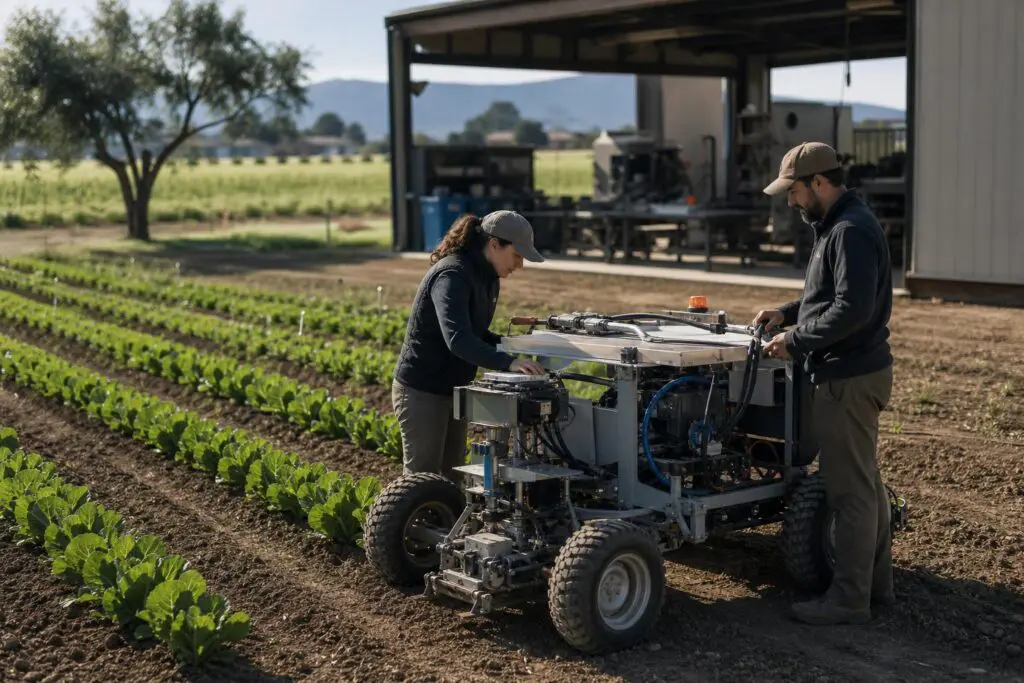
California agricultural technology companies face a commercialization test that goes beyond making a machine or software product work: finding growers whose operations need it and earning their confidence. UC ANR Connect addresses that task by screening commercially available technologies against grower priorities, then putting companies into conversations with agricultural users and advisers before adoption decisions.
The program’s approach puts business readiness alongside technical capability. Separately, Reservoir Farms in Salinas offers startups membership options built around industry relationships and access to working space. These efforts address different parts of the route from a developer’s product to a grower’s operation: understanding the customer and obtaining a place to work with agriculture.
“Entering the California market requires more than a strong technology. Companies need to understand how farmers make decisions, how their products fit into agricultural operations and what it takes to earn trust,” said Helle Petersen, director of UC ANR Innovate, in the university’s Aug. 31 description of Connect.
Screening for a market, not just an invention
Connect is operated by UC ANR Innovate, the innovation arm of University of California Agriculture and Natural Resources, in partnership with Farmhand Ventures. Its stated focus is commercialization, not simply identifying interesting inventions. The August program description sought commercially available products, placing the emphasis on companies ready to discuss agricultural use and market fit.
UC ANR Innovate’s advisory board and agricultural partners help identify priority needs and assess whether applicants offer commercially available solutions relevant to them. That creates two questions for selection: Is a product available, and does it address a problem growers have identified? Availability alone is not the program’s stated selection standard.
An October account by Hilary Rance, republished by the California Department of Food and Agriculture, adds detail about that screening. Connect reviews companies’ business models, teams and presentations. The account describes an application review followed by selection of 10 to 20 companies to pitch, with the highest-ranking and most established companies then invited into the program.
That review broadens the discussion beyond a product’s advertised function. A company must explain its business and present the people behind it, as well as the technology itself. Those are elements of Connect’s selection process, not a guarantee that a selected product will deliver a particular result on a farm.
Customer discovery before adoption
Once selected, participants speak directly with growers, UC Cooperative Extension advisors, researchers and industry partners through customer-discovery conversations and feedback sessions. UC ANR says the exchanges help companies refine their value proposition, strengthen market positioning and communicate with people who may use, recommend or support their products.
Customer discovery gives the grower a role before a purchasing decision. The company brings a commercially available solution; agricultural participants bring their operational constraints and questions. Connect’s stated purpose is to use those conversations to improve the company’s understanding of its market, rather than treating a finished product as the end of development.
In August, UC ANR reported that Connect had worked with 55 companies through eight program cycles during its first two years. Past participants’ technologies covered equipment automation, irrigation management, mechanical pollination, disease detection and harvest assistance, among other functions. Those figures describe program participation, not adoption rates or measured gains in farm performance.
The separate hurdle of field access
For smaller companies, understanding a customer does not automatically provide access to a field. Reservoir Farms was established around that separate difficulty. In September reporting by Enterprise Ag Magazine, Matthew Hoffman, general partner and head of Reservoir Farms, described the delay that can arise between startup funding and securing a grower relationship for testing.
Reservoir’s own research put that interval at about eight months. Hoffman illustrated the financial pressure with startups holding $100,000 to $500,000 in angel investment or their own capital. The eight-month figure is Reservoir’s estimate, not an independently established benchmark for all agricultural technology companies.
Reservoir offers different levels of participation. Its community membership provides networking with growers and established agricultural technology companies. Residence membership adds access to office, shop and field space. The distinction gives companies separate options for building relationships and obtaining a physical base for development, rather than requiring every participant to use the same arrangement.
TRIC Robotics illustrates a planned move between those levels. Founder and CEO Adam Stager said in the September report that the company, then a community member, planned to become a residence member in 2027 as it prepared to expand into the Salinas Valley. That was a company plan, not a completed membership change or expansion.
The next steps differ by company and program: Connect participants work on customer understanding and market positioning, while Reservoir members can seek relationships or resident access according to their development needs. Neither selection nor membership substitutes for a grower’s assessment of a product’s fit. The support described here concerns reaching that assessment with a clearer business case and access to agricultural users.