A representative migratory beekeeping operation supplying California almond orchards can cover its annual cash bills with assumed federal assistance, yet still fall short of funding long-term equipment replacement. That distinction anchors an October 15 University of Illinois analysis estimating a $31-per-colony return above cash costs but a $62-per-colony loss after capital recovery.
Researchers Brittney Goodrich and Allison Altschuler modeled an 8,500-colony operation for 2025-2026, rather than measuring the finances of a particular business. Their findings show how almond rental income, honey sales, colony health expenses and government payments interact in one operating budget. The results are not an industry-wide estimate of beekeeper profitability.
The model follows a three-state business: summer honey production in North Dakota, colony management at Texas holding yards and late-winter almond pollination in California. Its 8,500-colony benchmark represents the maximum number of strong summer colonies available for honey extraction, not the number the operation expects to deliver to almond orchards.
What the model assumes
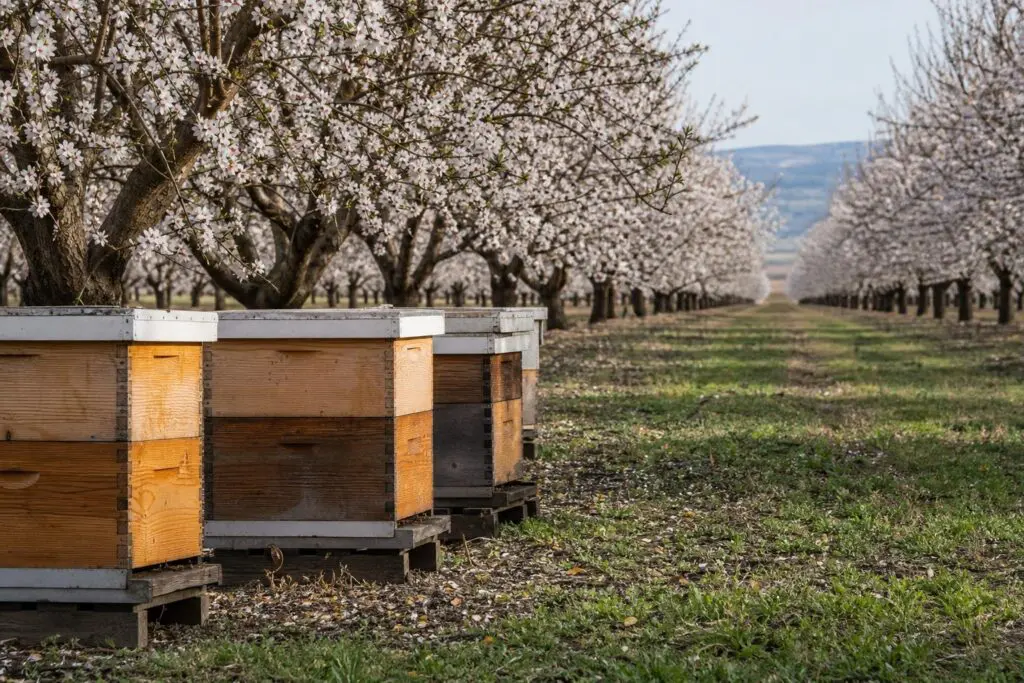
The revenue assumptions include renting 5,000 colonies for almond pollination at $195 each, producing an average of 70 pounds of honey per colony and selling honey in bulk for $1.90 per pound. The researchers also include payments under USDA’s Emergency Assistance for Livestock, Honey Bees, and Farm-Raised Fish Program, known as ELAP.
Those assumed assistance payments exceed the operation’s net return above cash expenses. Without them, the modeled business would not cover its annual cash costs, the authors report. This is a budget assumption tied to modeled colony losses, not a determination that any particular beekeeper qualifies for assistance or would receive the same payment.
Cash expenses and capital recovery answer different financial questions. Cash costs capture annual outlays, including operating expenses and business overhead. Capital recovery accounts for the longer-term cost of equipment and other apiary investments. Using an 8.25% interest rate for that calculation, the researchers find that the positive cash margin becomes a loss.
Labor and colony health drive expenses
Labor takes the largest share of operating expenses at 32%, followed by transportation at 25%, feed at 18% and Varroa mite treatments at 16%. These percentages describe operating costs, not the entire budget. Operating costs account for 59% of total costs, with cash overhead at 14% and noncash overhead at 27%.
Keeping colonies healthy and rebuilding inventory also carries costs across several categories. Feed, Varroa treatments and purchased bees together account for about 41% of operating expenses, before counting the additional labor devoted to colony health and replacement. The model assumes annual colony losses equal to 44% of the maximum summer inventory.
Surviving colonies still must qualify for rental
For almond pollination, surviving winter is not the same as producing a rentable colony. The baseline assumes that about 99% of 5,036 surviving colonies meet rental requirements, which the authors describe as relatively favorable. Some surviving colonies may lack the strength required by pollination contracts and therefore generate no almond rental revenue.
That distinction changes the cash outlook in the researchers’ sensitivity test. If only 70% of surviving colonies can be rented at $195 each, the modeled operation no longer covers annual cash costs. The test isolates a practical financial vulnerability: the share of surviving colonies that can actually earn a pollination fee.
Honey income provides another source of exposure. At the assumed $1.90-per-pound price, the operation still covers cash costs if average yield falls to 55 pounds per colony. But if both yield and price fall by 20%, it encounters short-term cash-flow problems. Only the most favorable honey scenario tested covers total costs, including capital recovery.
The preparation behind those almond rentals starts well before bloom. In their February 2025 migration analysis, Goodrich and Altschuler described late-summer and fall colony preparation, followed by shipments to California holding yards from December through February and final inspections before orchard placement. California’s almond-growing regions cannot sustain the needed concentration of colonies year-round, making that seasonal movement central to pollination.