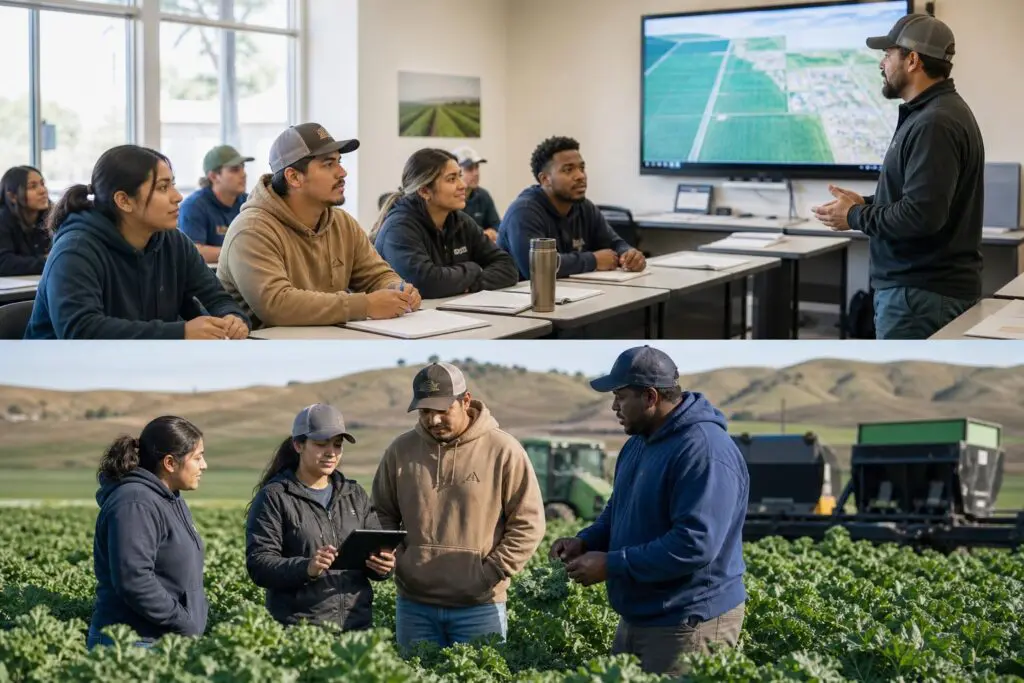
California’s Department of Industrial Relations (DIR) announced a $15.9 million investment supporting 67 apprenticeship programs, aiding approximately 10,000 apprentices statewide. This funding, part of the Apprenticeship Innovation Fund (AIF), aims to expand earn-and-learn opportunities and develop career pathways across industries including agriculture and technology.
The AIF has invested $88 million in total, supporting nearly 40,000 apprentices in 92 programs, with average hourly compensation of $51.74. Non-traditional apprenticeships have grown 76 percent in sectors such as healthcare, education, advanced manufacturing, and technology across California’s economy.
Several grant recipients highlight diverse apprenticeship impacts. The Early Care & Education Pathways to Success program received nearly $1.9 million to train 775 apprentices addressing childcare professional shortages. LAUNCH Apprenticeship Network supports 582 apprentices with $1.7 million, focusing on fields like industrial automation and robotics, with emphasis on expanding women’s participation in male-dominated trades.
The Santa Clara Valley Transportation Authority (VTA) Joint Apprenticeship Training Committee received $680,000 supporting 251 apprentices in high-skilled transit roles, offering mentoring and hands-on training in rail maintenance, welding, and safety.
AIF uses a streamlined formula funding approach, reimbursing programs for operational or training expenses. This model boosts program scalability and employer engagement, under DIR’s Division of Apprenticeship Standards, whose mission is to develop skilled workforce pathways through innovative apprenticeships.
On research infrastructure, the University of California Agriculture and Natural Resources was awarded nearly $1.5 million from USDA’s National Institute of Food and Agriculture, matched by UC ANR to total almost $3 million, to establish the Agricultural Research and Innovation Laboratory Complex.
New Research Laboratory Boosts San Joaquin Valley Science Capacity
Located at UC West Side Research and Extension Center in western Fresno County, the complex will provide controlled laboratory units enabling immediate onsite analysis of soil, water, plant, pest, and environmental samples. This will speed diagnosis of agricultural challenges like drought, pests, and soil quality concerns faced by San Joaquin Valley farmers.
The facility complements field research by enhancing data quality and collaboration, while offering meeting and training spaces to expand extension activities, workforce development, and engagement with UC campuses, CSU Fresno, USDA researchers, and industry partners.
In regulatory policy, the USDA’s Rural Business-Cooperative Service implemented a final rule effective July 9, 2026, revising the Biorefinery, Renewable Chemical, and Biobased Product Manufacturing Assistance Loan Program (Section 9003 program).
Updated USDA Loan Program Rules Promote Accountability
This program provides loan guarantees up to $250 million supporting advanced biofuels, renewable chemicals, and biobased product technologies. The rule updates strengthen oversight and prevent borrowers or guarantors who cause monetary losses to the agency from remaining involved in projects.
Specifically, debt write-downs are barred when borrowers or guarantors retain decision-making authority. Also, parties related by non-arm’s length transactions cannot remain involved if the agency sustains a loss, closing loopholes that previously allowed failed project operators to profit at taxpayer expense.
Updated policies aim to enhance program integrity, reducing fraud and encouraging commitment to successful project execution to support sustainable rural economies and the bioindustrial sector.
Evolving Fumigation Research and Practices in California’s Tree Nut Industry
In pest management for the state’s vital tree nut industry, fumigation remains essential yet increasingly regulated. The Western Tree Nut Association reports elevated attention from state and federal regulators including California’s Department of Pesticide Regulation and air quality agencies.
At a recent WTNA Fumigation Summit, experts emphasized fumigation as a science-driven process where correct pest identification, fumigant concentration, temperature, and exposure time are critical for effective treatment performance.
New research on roof rat management in Central Valley nut orchards highlights burrow fumigation methods. Roof rats damage nuts, branches, and irrigation infrastructure, and have adapted to use ground burrows in orchards, allowing targeted fumigation.
Three fumigation methods—aluminum phosphide, pressurized exhaust (carbon monoxide), and carbon dioxide injection—showed at least 70% efficacy in trials, with aluminum phosphide achieving close to 80% average efficacy in field evaluations across orchard sites.
Soil moisture is crucial for fumigant effectiveness; moist soil retains fumigants whereas dry soil allows gas escape. While aluminum phosphide is effective and quick to apply, it carries notable use restrictions. Pressurized exhaust is highly effective but slower.
Experts recommend integrating fumigation with trapping, baiting, habitat modification, and biological controls for comprehensive roof rat management. Compliance with evolving regulatory requirements and air quality permits is essential to avoid operational delays.
With fumigation costs rising, growers are urged to adopt monitoring technologies to document treatment conditions and ensure value. Proactive engagement with air districts before operational changes will help maintain regulatory compliance.
Overall, California’s 2026 agricultural advancements reflect investments in workforce development, research innovation, regulatory integrity, and integrated pest management that together strengthen the state’s agricultural economy and sustainability.
These developments position California to better meet challenges such as labor needs, water scarcity, pest pressures, and shifting bioeconomy demands, ensuring continued productivity in leading specialty crop sectors.