Across the JCS Marketing network Visit JCS Marketing
MyAgCast Podcast Network

The Backyard Bouquet

Fresh episodes and conversations from the agricultural community.

Latest episodes ↓
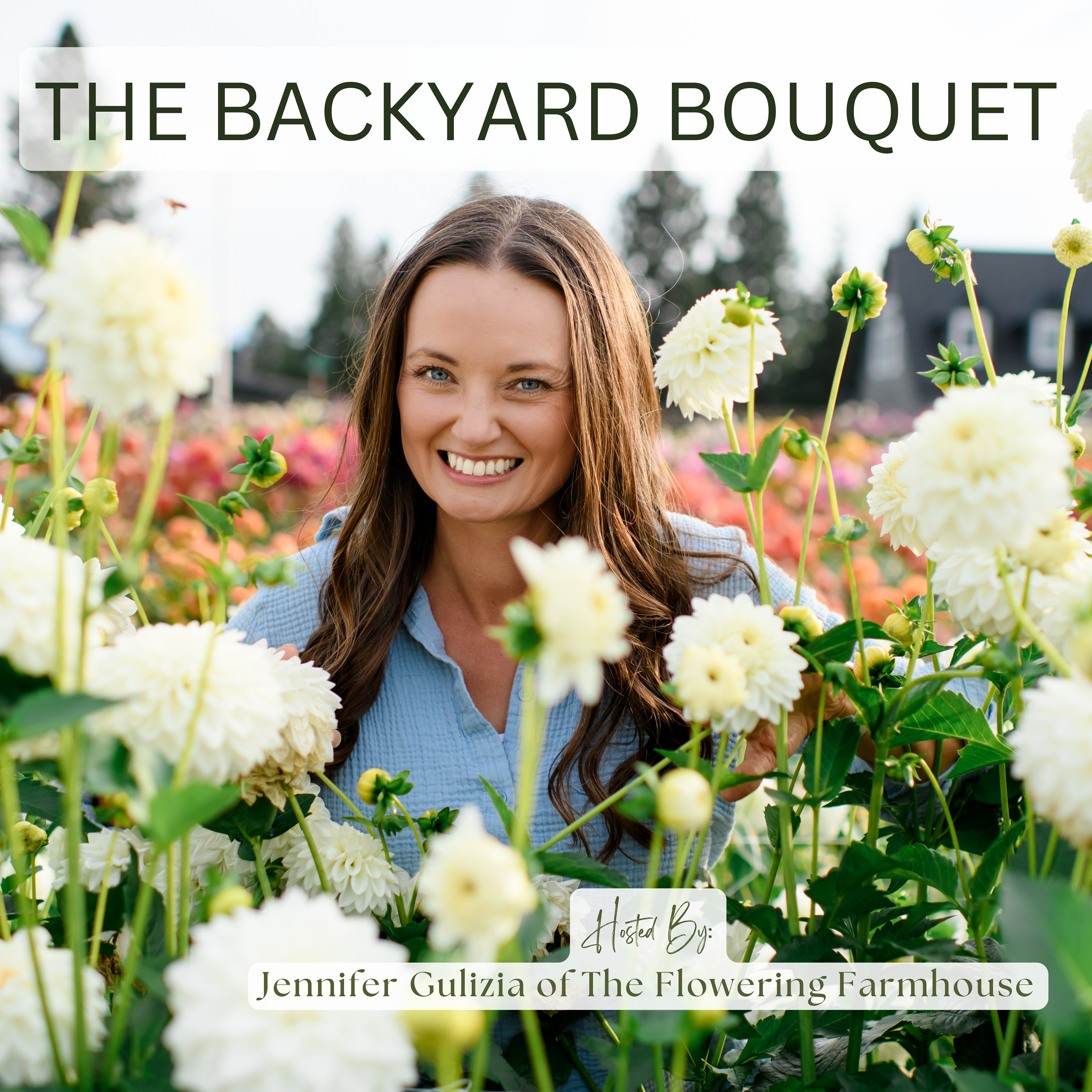
<p><strong>A podcast for flower farmers, gardeners, and cut flower growers who are growing more than just flowers.</strong></p><p>Hosted by Jennifer Gulizia of The Flowering Farmhouse, <em>The Backyard Bouquet</em> shares inspiring conversations and expert tips from the fields and gardens of cut flower farmers and home growers.</p><p>Whether you're planting your first backyard bed or running a thriving flower farm, each episode offers practical growing advice, heartfelt stories, and the encouragement to cultivate beauty, joy, and connection—both in your garden and in your life.</p><p>From backyard plots to blooming fields, this podcast celebrates the people behind the petals and the lessons we learn when we grow with intention. Discover how locally grown flowers can enrich your days, root you in the present, and remind you that every flower—and every season—has a purpose.</p><p><strong>Join us on this flourishing journey—where growing flowers is just the beginning.</strong></p><p><strong>For Show Notes And More Podcast Details: </strong><a href="https://thefloweringfarmhouse.com/the-backyard-bouquet-podcast/">https://thefloweringfarmhouse.com/the-backyard-bouquet-podcast/</a></p><p><strong>Sign up for our newsletter: </strong><a href="https://thefloweringfarmhouse.myflodesk.com/backyardbouquetpodcast"><strong>https://thefloweringfarmhouse.myflodesk.com/backyardbouquetpodcast</strong></a></p><p><strong>The Flowering Farmhouse: </strong><a href="https://www.instagram.com/thefloweringfarmhouse/"><strong>Instagram</strong></a><strong> | </strong><a href="https://www.facebook.com/thefloweringfarmhouse"><strong>Facebook</strong></a> <a href="https://www.pinterest.com/thefloweringfarmhouse/"> </a><strong>| </strong><a href="https://thefloweringfarmhouse.com/"><strong>Website</strong></a></p>

Recent Episodes
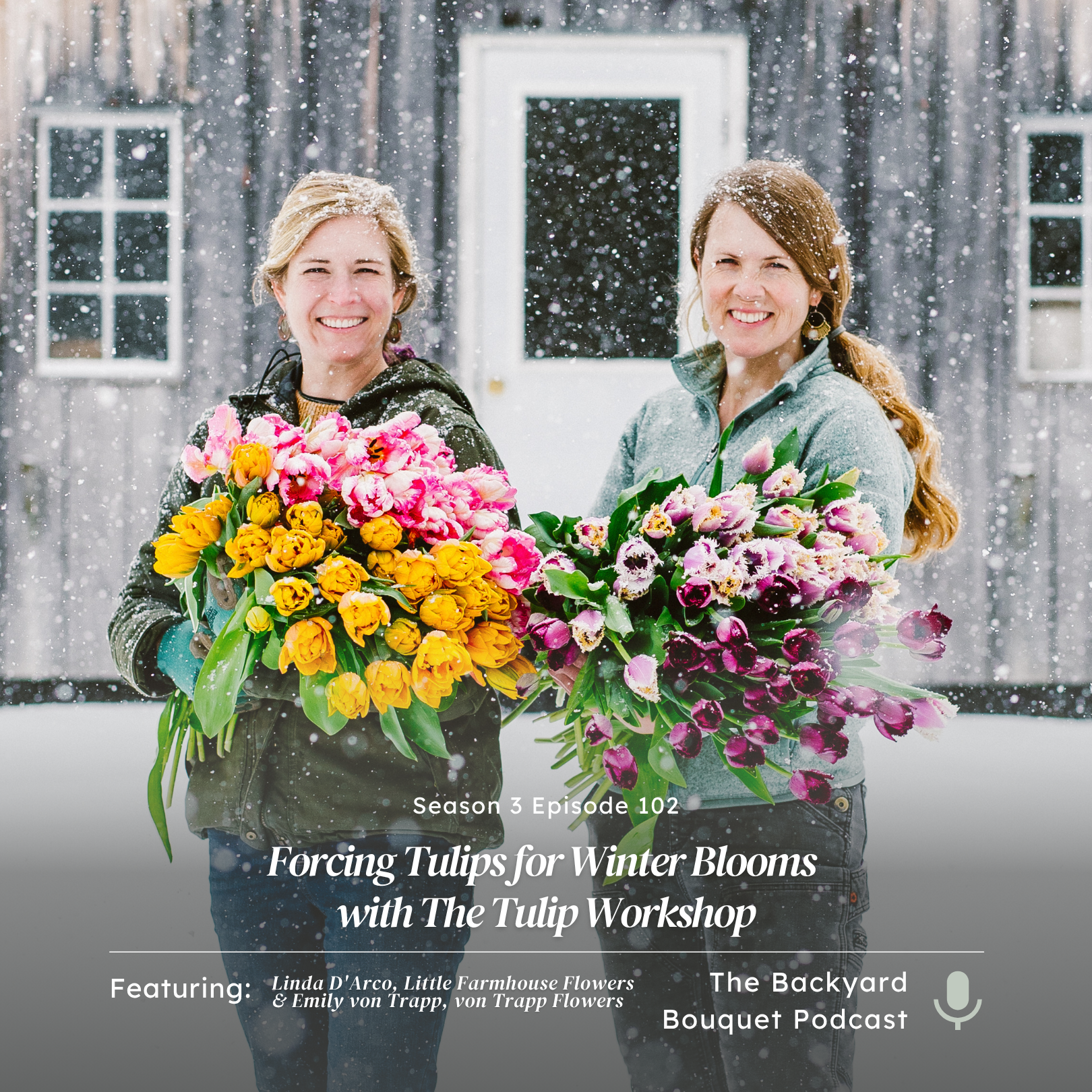
Ep.102: Forcing Tulips for Winter Blooms with The Tulip Workshop

Ep.102: Forcing Tulips for Winter Blooms with The Tulip Workshop

October 15, 2026 1:06:24
Episode notes

Most of us think of tulips as a spring flower. Emily von Trapp and Linda D'Arco built their businesses on proving otherwise.

Emily grows 200,000 tulips a year in Waitsfield, Vermont, all of them in crates, in soil, blooming in the dead of a Vermont winter. Her first stems come around January 7th. Linda grows in Jay, New York, up in the Adirondacks. She forces hers hydroponically, and she started in the basement of a little farmhouse.

They met in a Facebook group. Linda saw Emily's photo of tulips blooming in January and asked what the magic was. Then she talked Emily into teaching it. Today they run The Tulip Workshop together.

In this episode we get into:

  • What forcing actually is, explained for farmers and backyard gardeners both
  • What 5C and 9C mean, and why the variety matters as much as the number
  • Soil versus hydroponic, from two growers who each chose differently
  • The three mistakes that cost people their crop
  • Why your bulb order got canceled this fall, from someone who imports them

If you have bulbs showing up at your door this month, this episode is for you.

ABOUT OUR GUESTS

Emily von Trapp grows flowers in Waitsfield, Vermont, on land her family has farmed for three generations. Her grandparents bought it as a dairy farm in the late 1950s, and her parents ran a retail nursery there for 42 years. She was selling bouquets at the local farmers market by the time she was twelve. Today she grows around 200,000 tulips a year for a winter CSA with 350 members across 13 pickup sites, plus up to 15 markets and shops throughout Central Vermont. Her tulips run January through June. Her lilies run April through January.

Connect with Emily:

Linda D'Arco grows on two and a half acres in Jay, New York, inside the six million acre Adirondack Park. She spent fourteen years in independent schools as an art and design teacher and a faculty dean before flowers took over. She learned forcing at one of Emily's first workshops in 2018, went hydroponic after a research trip to the Netherlands, and now runs Ampersand Bulb Co, a wholesale bulb import company.

Connect with Linda:

Find them together:

Connect with Jennifer, Host of The Backyard Bouquet Podcast:

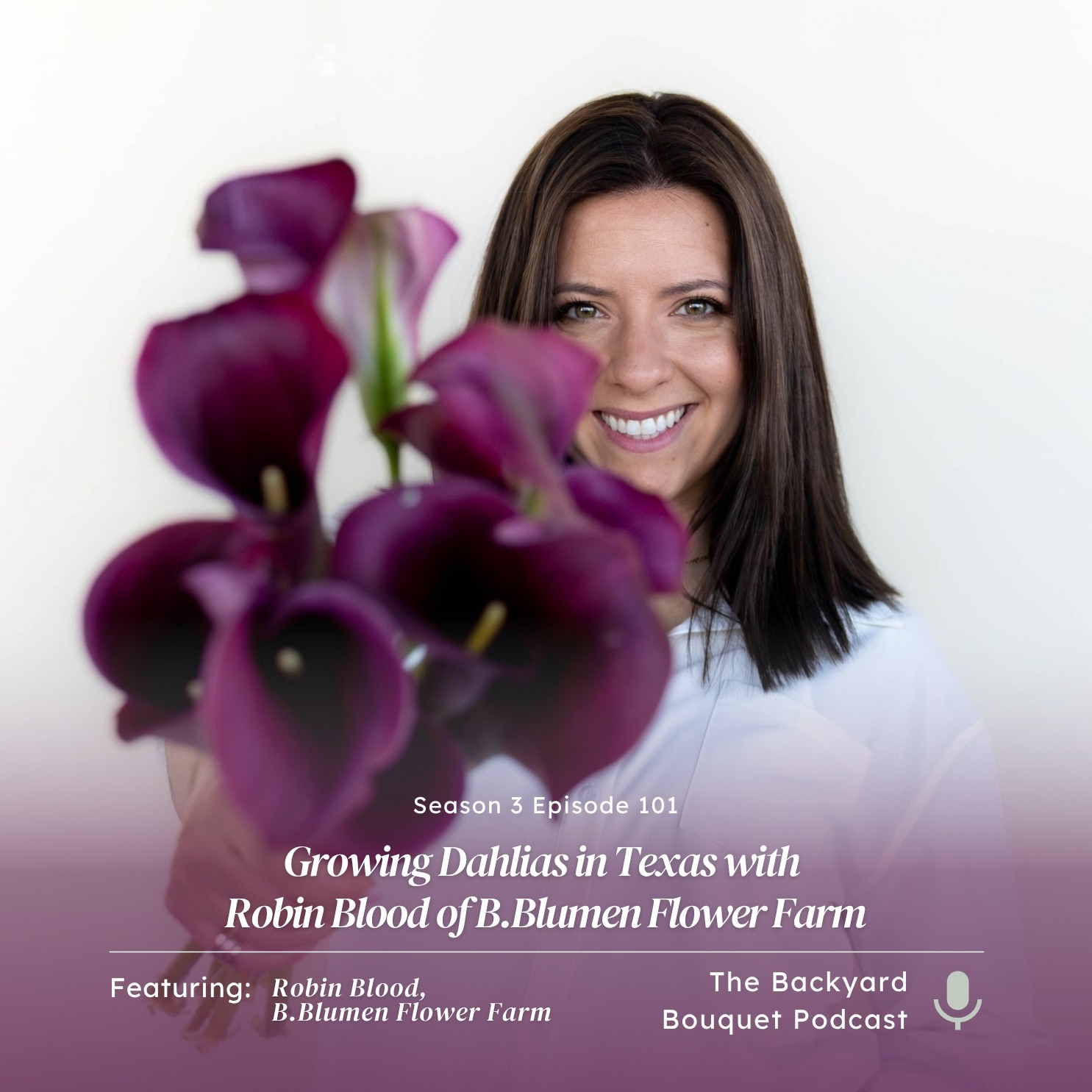
Ep. 101: Growing Dahlias in Texas with Robin Blood of B.Blumen Flower Farm

Ep. 101: Growing Dahlias in Texas with Robin Blood of B.Blumen Flower Farm

October 8, 2026 1:09:03
Episode notes

Everyone says dahlias need cool nights, and Robin Blood grows them in Godley, Texas, where the summer hits 105 and the grasshoppers came in like a plague her second year.

When Robin sent off her first soil sample, the lab wrote back that they did not recommend growing there, with no organic matter, no phosphorus, and a pH of 7.9. She and her husband Jeff had already stood up old telephone poles for a fence, so they stayed and built the soil instead. Today B.Blumen is a flower farm and wedding design studio serving Dallas Fort Worth, with a team of designers Robin trained herself.

In this episode you'll hear:

  • How Robin shades her dahlias through a Texas summer with no trees on the property, why she lets them rest in July, and why ball varieties hold up when dinnerplates struggle
  • The rabbit manure that rebuilt her soil, and how she traded labor to get it
  • The second season she lost nearly every dahlia, and what it taught her about stressed plants and pests
  • How a well shed turned into a design studio once she realized design made every stem she grew worth more

If you've ever been told your climate or your soil makes dahlias impossible, this conversation is for you. Subscribe so you don't miss an episode, and send this one to a grower who needs it.

About Robin

Robin Blood is the founder and creative director of B.Blumen, a flower farm and floral design studio in Godley, Texas. Her German mother called her Blumen, the German word for flowers, when she was a girl. Robin grew up in a German household with a lot of gardening, and one of her first jobs was picking snails off her mother's plants for a penny apiece.

She spent her early career in small businesses, became a director of sales at twenty, and left it all in 2020 to farm eleven acres of limestone and sand. Today B.Blumen grows without pesticides, no-till, and serves weddings across Dallas Fort Worth with a team of designers Robin trained herself.

CONNECT WITH ROBIN

Connect with Jennifer, Host of The Backyard Bouquet Podcast:

Robin and I talked about the Dahlia Design Summit in this episode. If you missed it live, All-Access Replay Tickets are still available here: https://thefloweringfarmhouse.mykajabi.com/dahlia-design-summit 

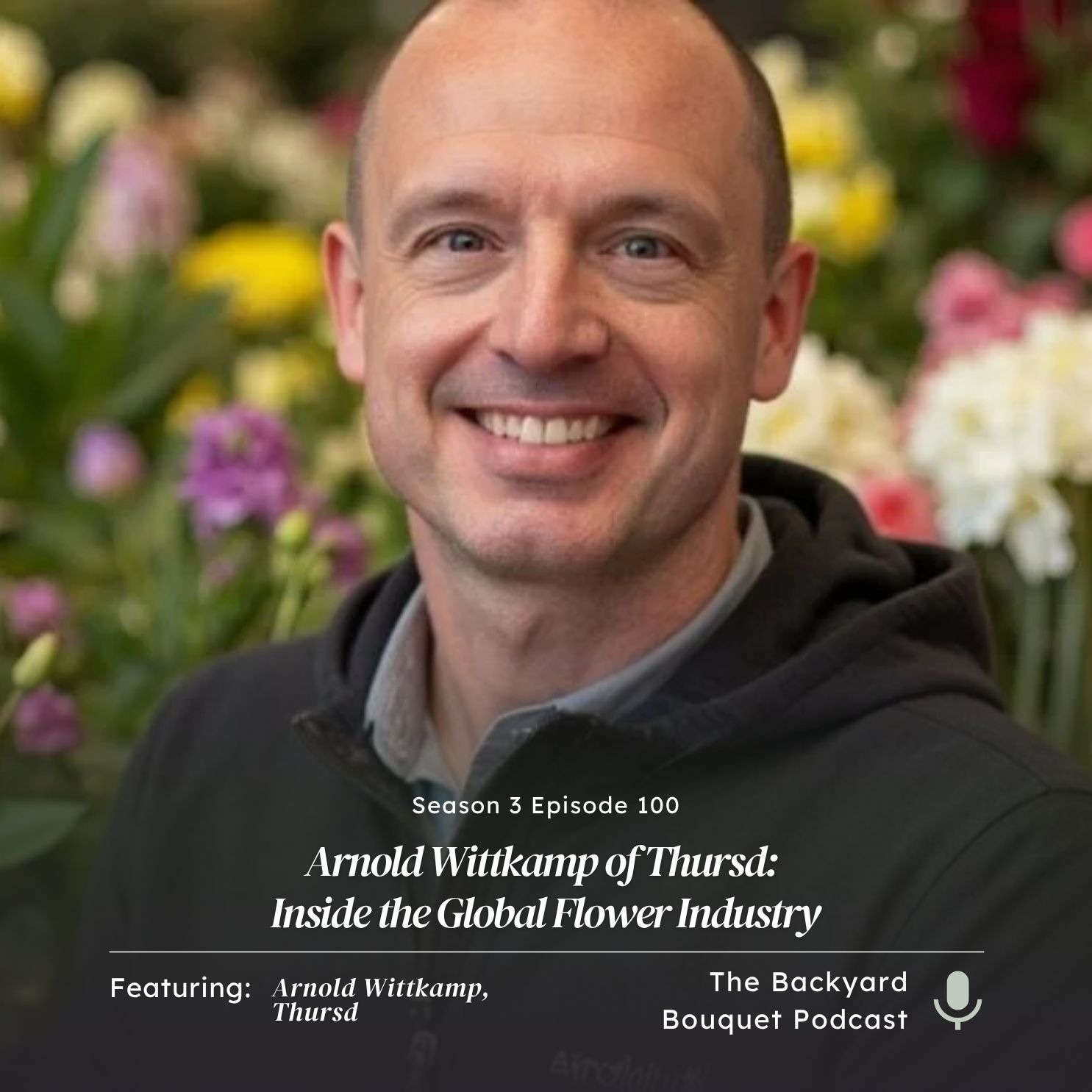
Ep.100: Arnold Wittkamp of Thursd: Inside the Global Flower Industry

Ep.100: Arnold Wittkamp of Thursd: Inside the Global Flower Industry

October 1, 2026 1:09:23
Episode notes


About eighty percent of the flowers sold in this country are imported, and I have said for years that local growers are not competing with each other, we are competing with that eighty percent. So this week I wanted to understand it better, from someone who knows it from the inside.

Arnold Wittkamp is the founder of Thursd, the global online magazine for the flower and plant industry, and he came to it after thirty five years in the trade that started on the floating flower market in Amsterdam when he was fifteen.

This is a different kind of episode for this show. On this podcast we typically focus on local flowers and the growers who grow local flowers, and this episode looks into the whole global system instead, into imports and exports and what a flower farm actually builds in a village in Kenya. I asked him the hard questions and he answered all of them.

Some of what we get into:

  • Why Arnold believes our industry told the wrong story about sustainability, and what he thinks we should have said instead
  • What the flower trade has built for families in Kenya, Ethiopia, Colombia and Ecuador, told through one farm he watched change over ten years
  • Why he says anyone handling imported flowers every day should be wearing gloves
  • The oldest flower shop in Amsterdam, and the four words its owner said to every stem he unwrapped

This podcast still believes wholeheartedly in local flowers, and nothing in this hour changed that. We believe that they matter for our communities, they matter for the environment, and they matter for the people growing them.

Keep asking where your flowers came from, find your local flower farmer, and support them.

About Arnold Wittkamp

Arnold Wittkamp is the founder of Thursd, the global online magazine for the flower and plant industry, which he launched in September 2019 around the line Thursd is good for you. Thirty five years in the trade took him from the Amsterdam floating flower market to his own export company to importing scented garden roses into a European market that did not want them. Thursd works with growers, breeders and industry organizations including the Kenya Flower Council, the Ethiopian producers' organization, Asocolflores and Fairtrade. He is building Thursd Shop, a direct to florist sourcing platform that will be partly owned by the growers themselves. He also hosts a Dutch language podcast with more than sixty episodes on how people really feel about flowers.

Connect with Arnold:

Connect with Jennifer, Host of The Backyard Bouquet Podcast:

Website: https://thefloweringfarmhouse.com/

Instagram: https://www.instagram.com/thefloweringfarmhouse/

Follow the Podcast: https://www.instagram.com/thebackyardbouquetpodcast/

Sign up for our newsletter: https://bit.ly/thefloweringfarmhousenewsletter

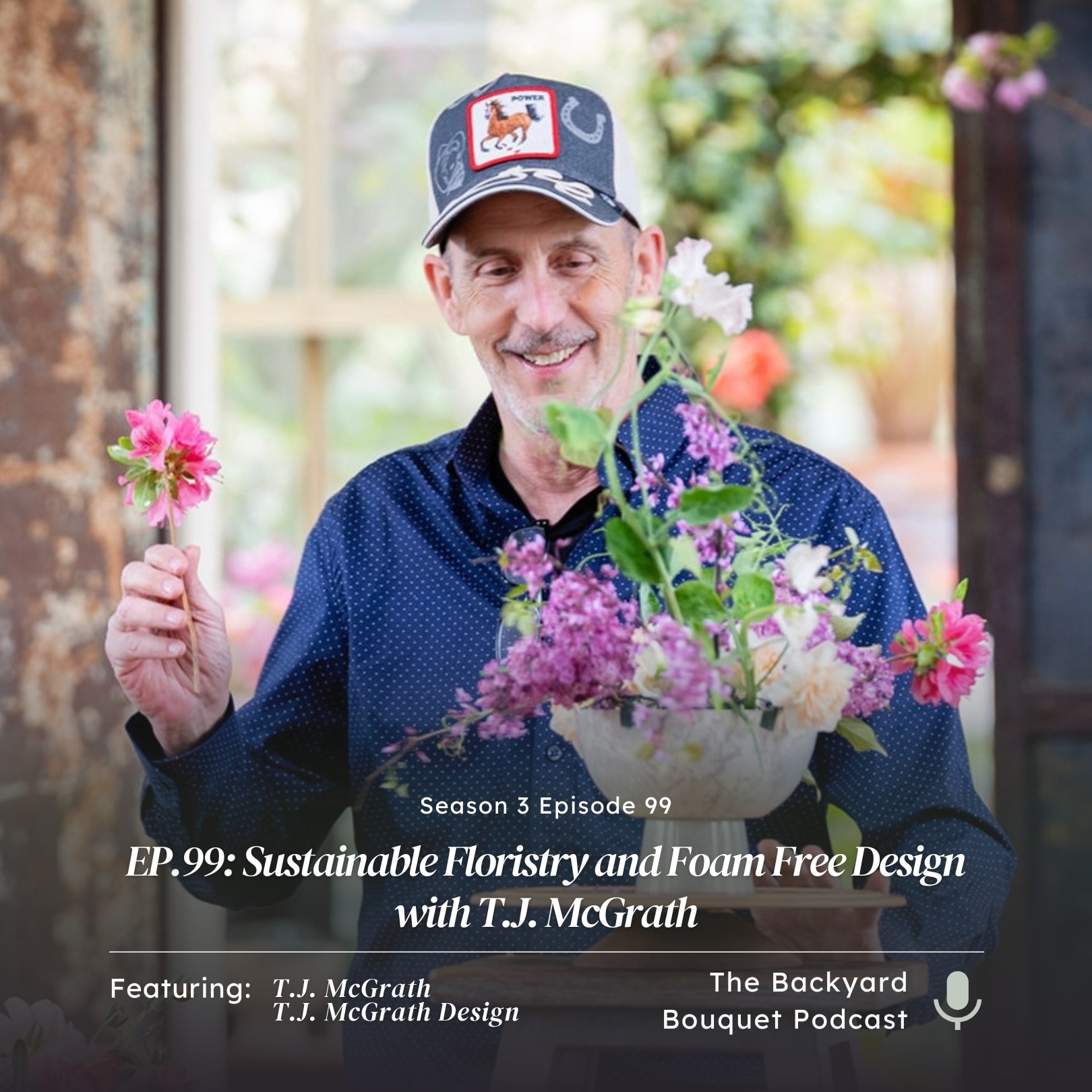
Ep. 99: Sustainable Floristry and Foam Free Design with T.J. McGrath

Ep. 99: Sustainable Floristry and Foam Free Design with T.J. McGrath

September 3, 2026 1:13:13
Episode notes

T.J. McGrath spent years in advertising, marketing, and retail before he ever touched a flower professionally. He was one of nine kids and never had a garden growing up. Then his partner told him he was miserable, pointed him toward a little shop with a flower cooler two towns over, and everything changed.

Today T.J. runs an entirely foam free studio in New Jersey, grows his own flowers at a cutting garden called Jardin de Buis, and teaches designers around the world how to work without single use plastic. In this conversation he is honest about all of it, including the part where he was the one who brought floral foam into the shop in the first place.

In this episode:

  • Why T.J. walked away from a job offer with medical benefits in the middle of a pandemic, and what his partner said that made the decision for him
  • The real reason floral foam is only a small piece of the sustainability picture, and what the industry keeps missing
  • What he tells students who freeze at the design bench because they are afraid of doing it wrong
  • The single most powerful thing a flower lover can do to change the floral industry, and it takes about thirty seconds

If this conversation moves something in you, share it with a friend who needs to hear it. And if you have not yet, follow The Backyard Bouquet Podcast wherever you listen so you never miss an episode.

About T.J. McGrath

T.J. McGrath is the founder of T.J. McGrath Design, a sustainable floral studio in Long Valley, New Jersey. One of nine children and raised without a garden, T.J. came to flowers by an unlikely route: a literature and philosophy degree from Rutgers, followed by years in advertising, marketing, and retail. In 2015 he quit a job that was making him miserable and took a part time position at a flower shop to learn the trade from the inside. He helped grow that shop into a sought after event studio. In 2020, with $700 in savings and a pandemic underway, he opened his own business.

Today T.J.'s studio is entirely foam free and built on locally and American grown flowers. He grows his own at Jardin de Buis, a micro flower farm on a friend's property in New Jersey. Teaching is now the largest part of his business, and he leads workshops across the country and internationally, from Colorado to Brazil to Costa Rica.

Connect with T.J.: tjmcgrathdesign.com | Instagram @t.j._mcgrath_design 

T.J. heads to Costa Rica the first week of September to teach at Iberiata 2026, held at Hotel Los Lagos in the La Fortuna region. It is a celebration of forty years of a Latin American floral school, and his session is on designing a dinner table.

***Grab Your Dahlia Design Summit Ticket. Join us September 13 through 18. Six days of dahlia design taught by fourteen farmer florists and floral designers. Whether you're growing your first row or you're already selling to florists, every session is about doing more with the dahlias you already have in the ground. Live Pass is $147. All Access is $247 and you keep every session for life. Come join us: https://thefloweringfarmhouse.com/summit  ***

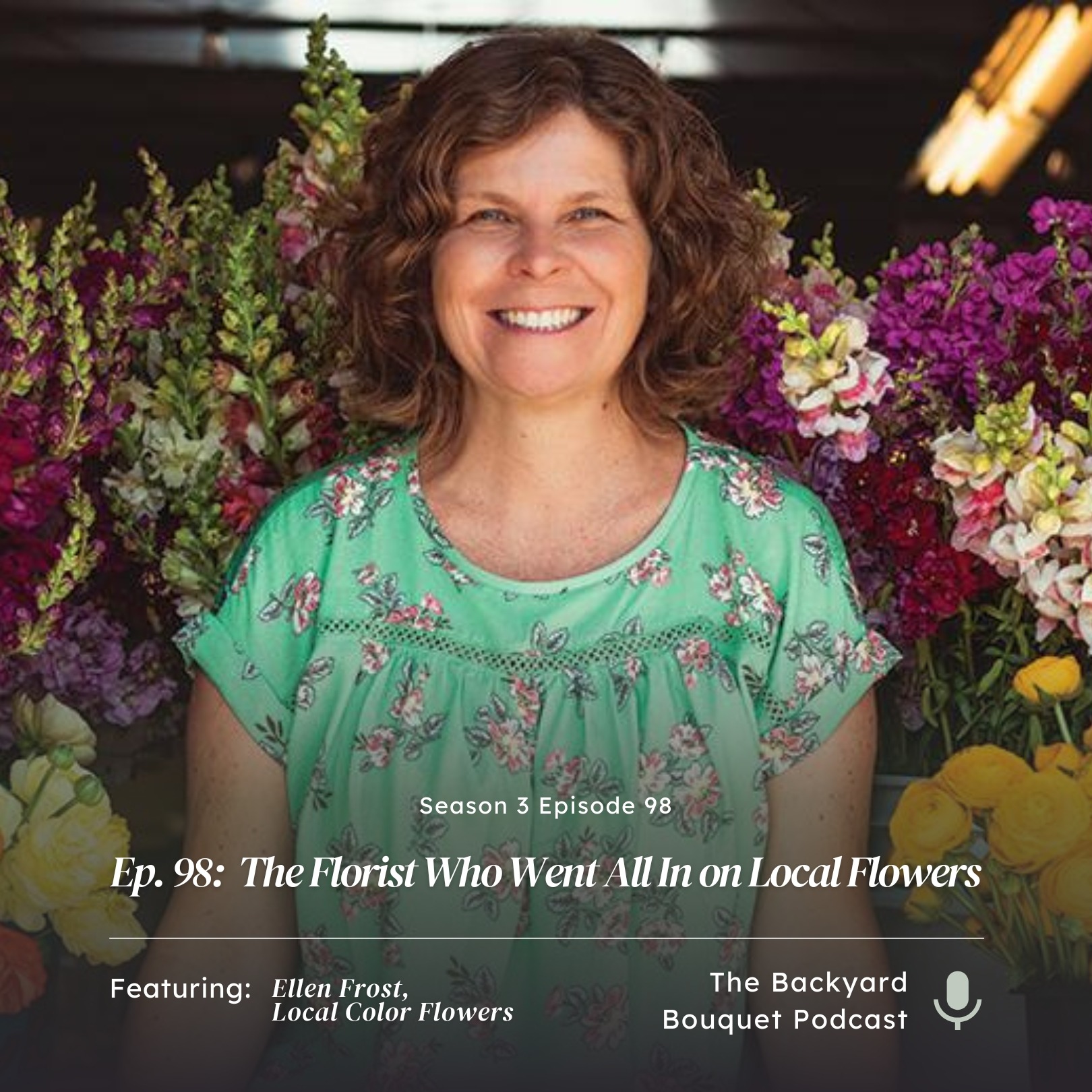
Ep.98: Ellen Frost: The Florist Who Went All In on Local Flowers

Ep.98: Ellen Frost: The Florist Who Went All In on Local Flowers

August 12, 2026 1:09:08
Episode notes

Some of the most beautiful lives begin by accident.

Ellen Frost was gifted a bag of tulip bulbs for her wedding. She had never planted a thing. She read the directions, put them in the ground, and when they came up that spring, something in her shifted. She grew up in a working class town in Buffalo with no connection to flowers or gardens or nature, and yet that one small spring miracle set the course for everything that came next.

Today Ellen runs Local Color Flowers in Baltimore, one of the early pioneers of the local flower movement in this country. Every stem she uses is grown within a hundred miles of the city. But this conversation is about so much more than sourcing. It is about being a bridge between farmers and the people in your community. It is about the courage to say no so you can say a bigger yes. And it is about the relationships that turn out to be the real harvest.

Ellen shares the moment she read Flower Confidential and understood the global flower system for the first time, the year she peaked at 150 weddings and nearly broke her body doing it, and the decision to scale down to 30 that saved her business. She talks about the farmer-florist relationship like the matchmaking it really is, and she gets honest about what she believes now that she did not believe when she started.

Connect with Ellen and Local Color Flowers:

***Grab Your Dahlia Design Summit Ticket. Join us September 13 through 18. Six days of dahlia design taught by fourteen farmer florists and floral designers. Whether you're growing your first row or you're already selling to florists, every session is about doing more with the dahlias you already have in the ground. Live Pass is $147. All Access is $247 and you keep every session for life. Come join us: https://thefloweringfarmhouse.com/summit  ***

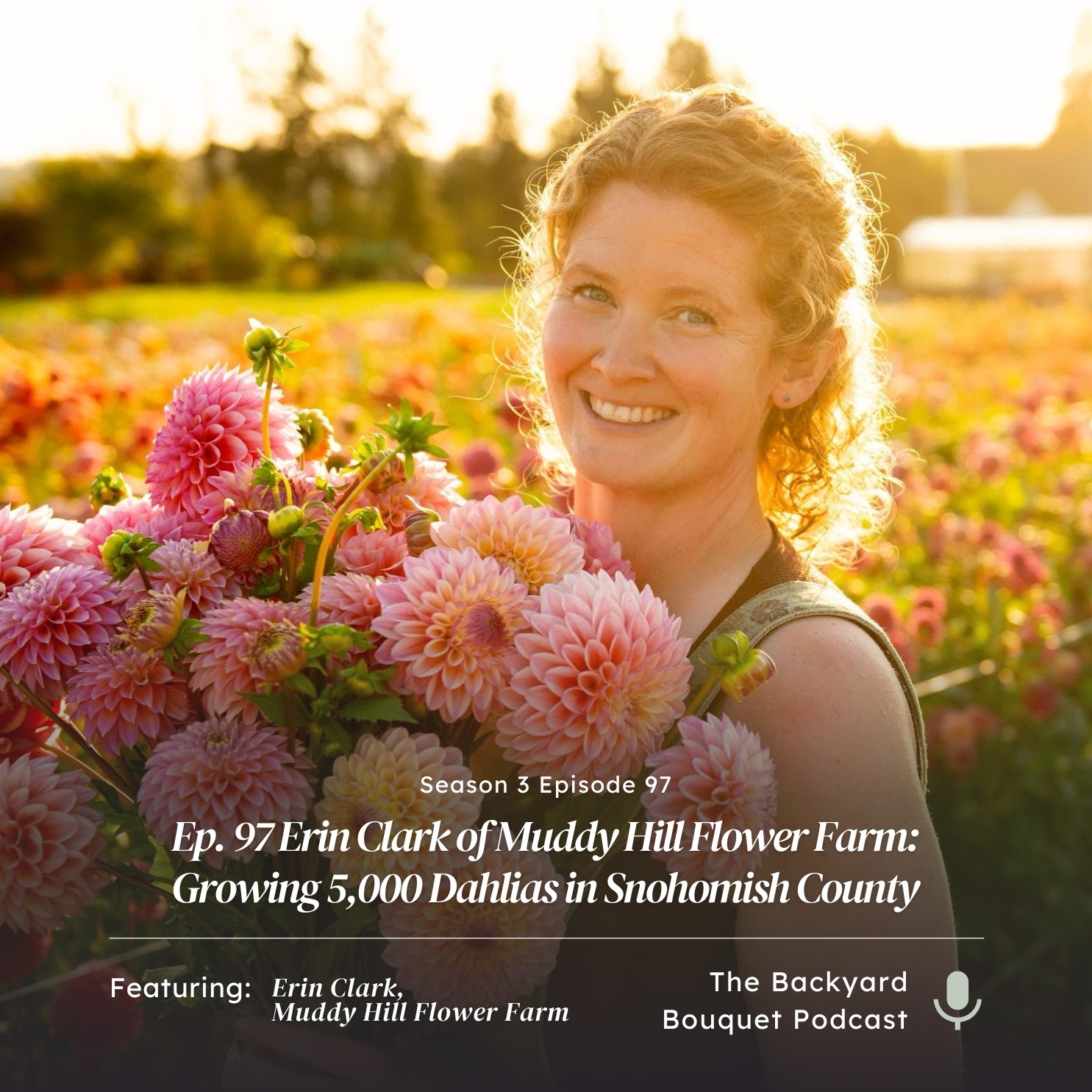
Ep. 97 Erin Clark of Muddy Hill Flower Farm: Growing 5,000 Dahlias in Snohomish County

Ep. 97 Erin Clark of Muddy Hill Flower Farm: Growing 5,000 Dahlias in Snohomish County

July 3, 2026 1:10:29
Episode notes

Some stories start with a grand plan. Erin Clark's started with five dahlias and a need to get outside.

In 2020, home with a new baby and a world gone quiet, Erin went looking for an outlet. She found it in a 60-square-foot patch of dirt. A neighbor walked by, saw her planting, and the next day her husband gifted Erin a whole tray of tubers. That neighbor turned out to be a dahlia hybridizer who lived right around the corner. That small act of generosity grew into Muddy Hill Flower Farm, where Erin now grows more than 5,000 dahlias on a field her husband once mowed for his dad's cattle.

In this episode, Erin and I talk about the messy, beautiful middle of building a flower farm. We get into soil tests and powdery mildew and the great vole wars. We talk about why she refuses to spray her field, what the Snohomish County Flower Collective means to her, and the brand-new community event she is helping bring to her town this fall.

And at the end, Erin shares something tender about what this work has given her. It moved me. I think it will move you too.

Key Takeaways

  • Generosity is contagious. One neighbor's gift of tubers started an entire farm.
  • You do not have to start big. Erin began with five dahlias in 60 square feet.
  • Local flowers are not the same product as imported flowers. Freshness, vase life, and how they are grown all matter.
  • Growing without chemicals is possible. Nematodes, lacewings, neem oil, and patience do a lot of the work.
  • Community beats competition. Flower farmers who buy and sell from each other serve their customers better.
  • The biggest reward is not the money. It is the confidence and courage that grow alongside the flowers.

Resources and Links Mentioned

Guest Bio

Erin Clark is the farmer and florist behind Muddy Hill Flower Farm in Snohomish, Washington. She grows locally loved cut flowers without herbicides or pesticides on three acres just outside town, and she is best known for her dahlias, with more than 150 varieties. Erin sells through her farm stand, DIY buckets, local wholesale, and the Snohomish County Flower Collective, and she is helping bring the first-ever Snohomish in Bloom celebration to her community this September.

Related Episodes

  • Episode 86 with Melissa Stewart of Sweet Bloom Farm 
  • Episode 61 with Jennifer Joray (the two-part conversation on ticks and organic, no-spray solutions)

***Grab Your Dahlia Design Summit Ticket. Join us September 13 through 18. Six days of dahlia design taught by fourteen farmer florists and floral designers. Whether you're growing your first row or you're already selling to florists, every session is about doing more with the dahlias you already have in the ground. Live Pass is $147. All Access is $247 and you keep every session for life. Come join us: https://thefloweringfarmhouse.com/summit  ***

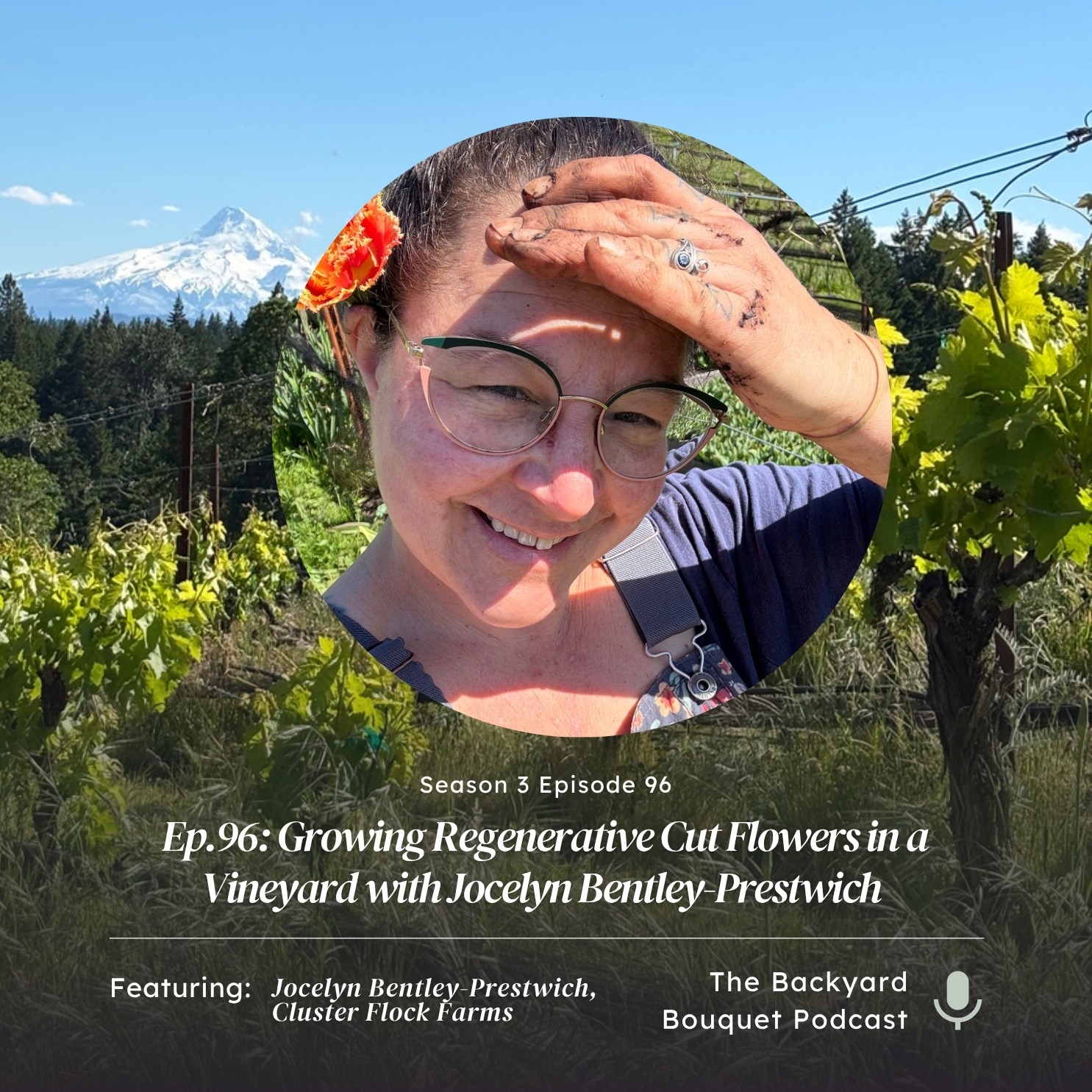
Ep. 96: Growing Regenerative Cut Flowers in a Vineyard with Jocelyn Bentley-Prestwich of Cluster Flock Farms

Ep. 96: Growing Regenerative Cut Flowers in a Vineyard with Jocelyn Bentley-Prestwich of Cluster Flock Farms

June 4, 2026 1:12:09
Episode notes

Jocelyn Bentley-Prestwich plants peonies, daffodils, and alliums underneath her grape vines, and she has quadrupled the value of every linear foot of her vineyard by doing it.

She runs Cluster Flock Farms and Vineyard on twenty-five acres in Husum, Washington, where she grows wine grapes for some of the best winemakers in the Columbia Gorge, raises chickens and ducks and geese, runs flower subscriptions and a flower stand on Highway 141, and books a la carte wedding florals. She is also a queer female farmer who walked into a male-dominated wine industry that did not make room for her, and refused to leave.

In this episode:

  • What it looks like to be a female farmer in a male-dominated industry, and the moment Jocelyn started saying "tell me I can't and I'll show you I can"
  • The regenerative companion planting strategy that increased the value of every linear foot of her vineyard by four times
  • The day she stopped calling her farm Blue Elk Farms and renamed it Cluster Flock, and how naming the mess set her free
  • "Side of the road mode," the lesson Jocelyn's mother taught her about letting go of what you cannot control
  • What she would tell the version of herself from ten years ago who did not yet know if she belonged

If you have ever felt behind, or like you do not quite belong, or like you are barely holding it together this season, this is your episode. Share it with another farmer who needs to hear it.

Guest Bio

Jocelyn Bentley-Prestwich is the owner of Cluster Flock Farms and Vineyard in Husum, Washington. She has been stewarding twenty-five acres in the Columbia Gorge since 2014 alongside her wife Lacy. Raised by a botanist mother and an organic chemist father, Jocelyn has been in plants her entire professional life. She started in horticulture as a teenager, worked in garden design and at-risk-youth education in the San Francisco Bay Area, and made her way to the Pacific Northwest with a long list of land requirements and a dream of building something diverse and regenerative. Today she grows Tempranillo, Gewurztraminer, Muscat, and Syrah grapes for Gorge winemakers, runs flower subscriptions, an a la carte wedding florals business, and a flower stand on Highway 141. She is a queer farmer, a mother, and a self-described nerd who believes everything is connected.

Connect With Jocelyn

For Show Notes And More Podcast Details: https://thefloweringfarmhouse.com/the-backyard-bouquet-podcast/

Sign up for our newsletter: https://thefloweringfarmhouse.myflodesk.com/backyardbouquetpodcast

Save the Date: The Dahlia Design Summit is coming September 13-18. Join the waitlist now for early-bird ticket access: https://thefloweringfarmhouse.myflodesk.com/dahliadesignsummitwaitlist

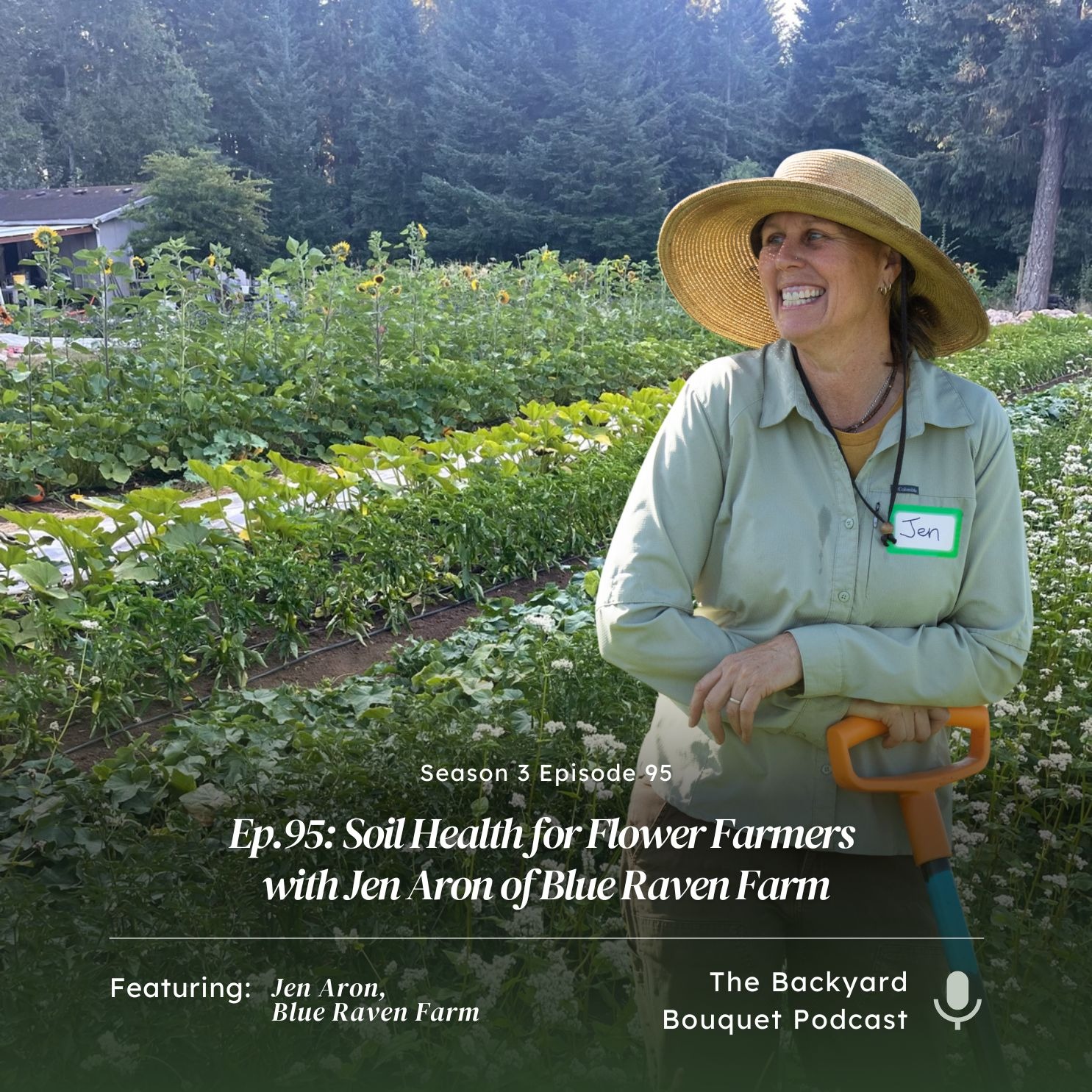
Ep.95: Soil Health for Flower Farmers with Jen Aron of Blue Raven Farm

Ep.95: Soil Health for Flower Farmers with Jen Aron of Blue Raven Farm

May 14, 2026 1:11:51
Episode notes

Today's guest is the woman I call when I have a real soil question.

Jen Aron is a regenerative farmer and soil agronomist at Blue Raven Farm in Corbett, Oregon, and she has spent the last decade quietly proving that soil is its own ecosystem with its own voice. In this episode we walk through what is actually happening beneath our feet, why compost may not be the answer you have been told it is, and the mantra she has taught me to repeat when farming feels too slow: trust and stay the course.

In this episode:

  • Why "no-till" is not the one-size-fits-all answer the internet wants it to be
  • The ball pit analogy that finally made soil structure click for me
  • Why too much compost can actually invite disease into your plants
  • The single tool Jen would buy on day one if she could start her farm over

Guest Bio

Jen Aron is the founder of Blue Raven Farm in Corbett, Oregon, where she has been farming regeneratively for ten years. She is an agroecologist, farmer, and educator. Before Blue Raven, Jen spent seven years with Oregon State University Extension, running a beginner urban farming program where she trained over a thousand new farmers. Today she consults with flower farmers, food farmers, and growers across the Pacific Northwest, helping them build soil that can actually hold a farm up.

Connect with Jen

Related Episode With Marion Boswall:

Sign Up For Podcast Newsletter: https://thefloweringfarmhouse.myflodesk.com/backyardbouquetpodcast

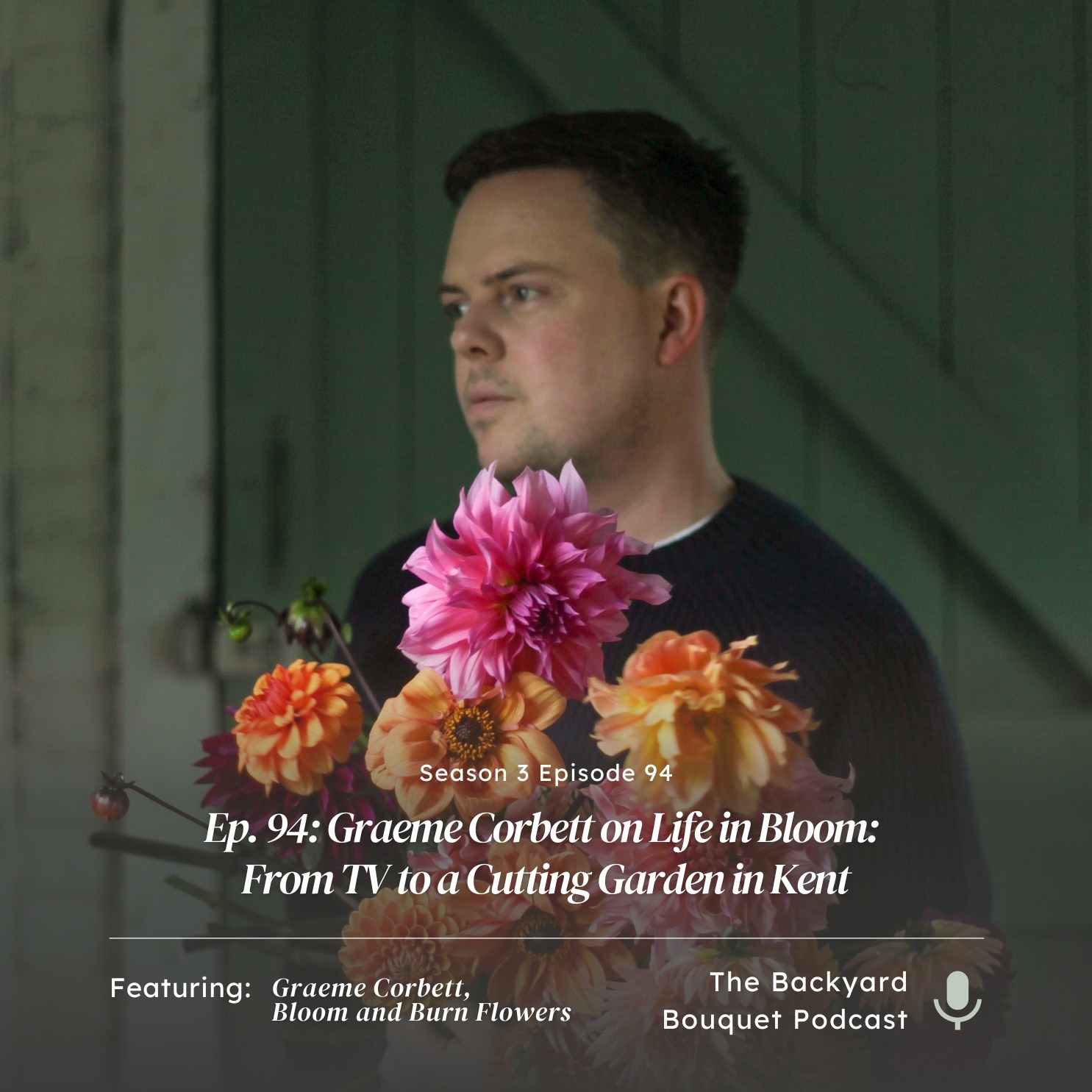
Ep.94: Graeme Corbett on Life in Bloom: From TV to a Cutting Garden in Kent

Ep.94: Graeme Corbett on Life in Bloom: From TV to a Cutting Garden in Kent

April 30, 2026 1:03:14
Episode notes

What does it actually look like to leave one career behind and walk into the one that's been waiting for you?

In this episode, Jennifer sits down with Graeme Corbett, the grower and storyteller behind Bloom & Burn, just weeks after the release of his brand new book Life in Bloom. Graeme spent years working in television in London, casting contestants for shows like The Voice and Celebrity Big Brother, before flowers found him. He talks about the long line of side projects that almost worked, the friend who told him to go to flower school, and the ten-year journey from a £7.50 posy at a London coffee shop to a cutting garden in Kent.

What you'll hear:

  • Why he calls himself a florist first and a grower second
  • How a £99 online course turned into his most powerful funnel
  • The honest story of writing a book when you don't come from money
  • Why "people can only say no" is the line that changed everything

If you have ever felt stuck in a career that doesn't quite fit, this one is for you.

Life in Bloom by Graeme Corbett (available in the UK and US through your local bookstore or online) https://amzn.to/3QFDCPv

Show Notes: https://thefloweringfarmhouse.com/2026/05/01/ep-94-graeme-corbett-life-in-bloom/

Guest Bio

Graeme Corbett is the founder of Bloom & Burn, a floral design studio based on a converted cow shed in Kent, England. After ten years in television casting, he pivoted to flowers in 2016 and has since built a workshop business that draws students from around the world. His first book, Life in Bloom, was released in April 2026.

Sign Up For Podcast Newsletter: https://thefloweringfarmhouse.myflodesk.com/backyardbouquetpodcast

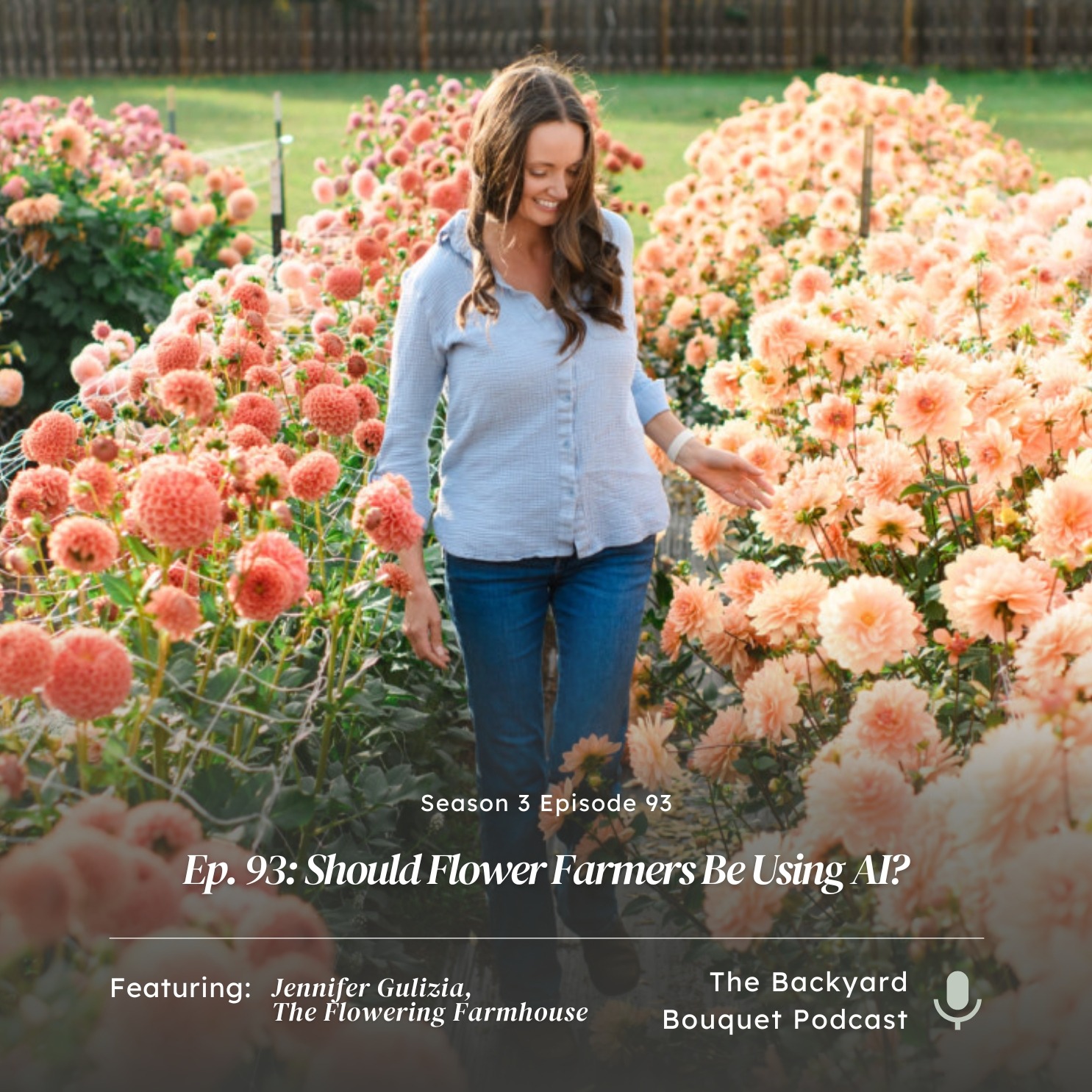
Ep.93: Should Flower Farmers Be Using AI?

Ep.93: Should Flower Farmers Be Using AI?

April 25, 2026 55:49
Episode notes

I've been using AI on my flower farm for over a year, and up until recently, I've only told a handful of people. Today I'm opening a conversation I haven't heard many in our industry having. It's a conversation every farmer deserves to be part of, whether you end up using AI or not.

In this solo episode, I share what I actually use AI for in my business, what I refuse to touch, and the ethical questions I've been living with: the data centers threatening the Hood River watershed, the training data taken without consent, the job displacement that's already real. I'm not here to convince you of anything. I'm here to make sure you have enough understanding to make the choice that's actually yours.

I talk about why the plow is the perfect metaphor for this moment. Why rare is going to matter in the age of AI-generated content. Why two things can be true at the same time. And why, on May 2nd, I'm hosting a workshop for flower farmers who want to learn how I use these tools to get back in the dirt.

Key Takeaways:

  • AI isn't new. What's new is the speed and the agentic leap. AI used to answer questions. Now it takes action.
  • The farmers who care most about the earth should not be the last ones at the table. They should be the first.
  • You can't advocate for or against a tool you have never touched. Curiosity is how you earn your seat in the conversation.
  • Two things can be true at the same time. AI can give small farmers their time back, and the data centers that power it can be threatening our watersheds. Both are real.
  • Boycotting is also a form of advocacy. The farmer who chooses not to use AI is doing something meaningful, and that choice deserves respect.
  • When everything online sounds the same, the voice that sounds like a real human is going to matter more than ever. Like a unicorn dahlia. Rare. Real. One of a kind.

You're Invited to Join Us For A 2 Hour AI Workshop on May 30th:

On May 30th I'm hosting a workshop called AI That Gets You Back in the Dirt. Two hours. Five tools. Live demos on a real flower farm business. No tech jargon. No rocket ships.

It's $47 to attend live, or $97 for VIP access which includes the lifetime replay, my Flower Farmer's AI Prompt Vault with over 50 prompts written for our industry, and my Voice Profile Builder so when AI helps you with your work, it keeps you sounding like you and not like every other AI-generated post on the internet.

Whether you decide to use AI or not is your decision alone. I respect whichever option you choose. What I do believe is that this is a conversation our industry needs to have. We need a voice at this table. And to have one, we have to understand what we are talking about.

Save your seat for May 30: https://thefloweringfarmhouse.mykajabi.com/AI-That-Gets-You-Back-in-the-Dirt

Connect With Jennifer

Show Notes: https://thefloweringfarmhouse.com/2026/04/25/ep-93-should-flower-farmers-be-using-ai/

ADVERTISEMENT
Agriculture, delivered.Subscribe to MyAgLife →

STAY CONNECTED

Get the latest ag news,
delivered to your inbox.

Your connection to California agriculture, wherever the day takes you.

Subscribe to MyAgLife