Higher diesel prices are adding to the estimated cost of fall fieldwork in Illinois, with tillage fuel surcharges ranging from $1.60 to $5.70 per acre, according to an October 20 university analysis. But the researchers say existing Illinois grain budgets already include most of the projected increase in annual fuel and oil expenses.
The analysis, by researchers affiliated with the University of Illinois, Ohio State University and the Illinois FBFM Association, separates two calculations: adjusting machinery costs for diesel purchased at fall prices and estimating fuel expenses across an entire crop year. Those calculations use different diesel prices and should not be treated as interchangeable.
Citing the Agricultural Marketing Service’s October 16 report, the authors put Illinois agricultural diesel at $5.63 per gallon, the highest in that reporting series, which began in September 2008. Their machinery examples use a rounded $5.60 price. The estimates concern Illinois grain production, not California operating costs or local custom-service quotes.
Calculating the machinery surcharge
The surcharge calculation starts with the difference between the current diesel price and the price built into an existing machinery estimate. Researchers multiply that difference by estimated gallons consumed per acre, then round the surcharge to the nearest 10 cents. Their 2025 machinery estimates used diesel at $3 per gallon.
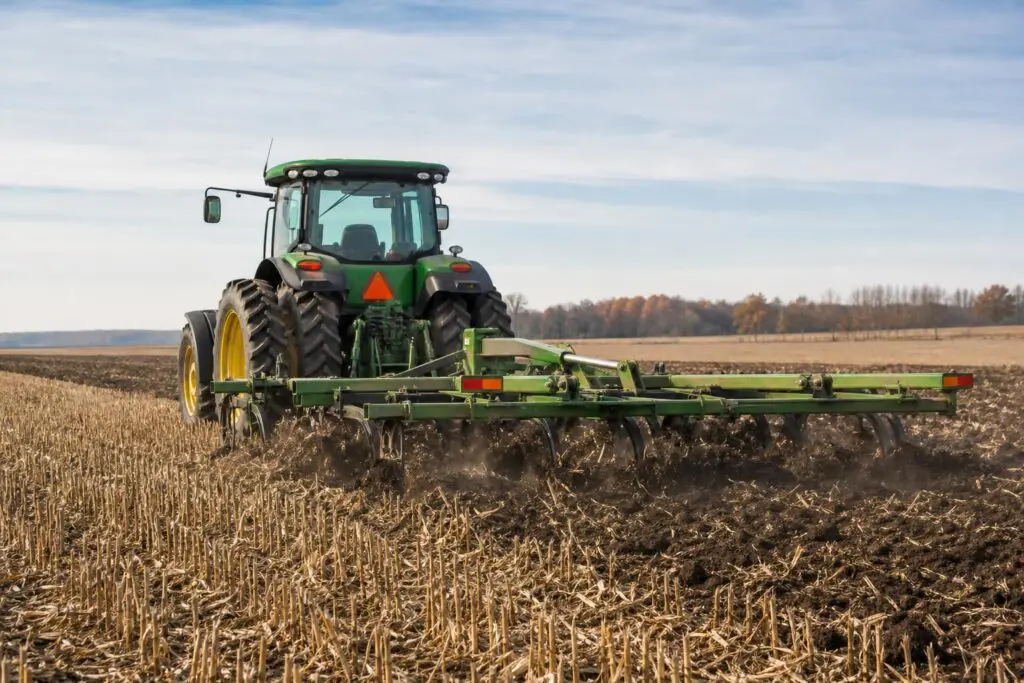
A chisel plow illustrates the calculation. The researchers’ baseline cost is $19.50 per acre, with estimated fuel consumption of 0.7 gallon per acre. Raising diesel from $3 to $5.60 adds $1.82 per acre in fuel expense. Rounded to a $1.80 surcharge, that brings the estimated operation cost to $21.30 per acre.
Fuel use also explains why the adjustment varies among operations. At the same $5.60 diesel assumption, researchers calculate a $2.80-per-acre surcharge for combining corn, which uses an estimated 1.07 gallons per acre. Combining soybeans, at 0.70 gallon per acre, carries a $1.80 surcharge. These are estimated fuel adjustments, not quoted custom-hire prices.
Fall prices differ from annual averages
The annual calculation uses a different assumption. If Illinois diesel prices remain at current levels through year-end, the researchers project a 2026 average of $4.30 per gallon. That is a conditional estimate, not a completed-year average, and it is lower than the $5.60 price used to calculate the fall machinery surcharges.
At that projected annual diesel price, the authors estimate fuel and oil expenses on high-productivity central Illinois grain farms at $28 per acre for corn and $24 for soybeans. Those amounts would exceed 2025 costs by $6 and $5 per acre, respectively. They cover annual fuel and oil expenses rather than one field operation.
Much of that increase was already anticipated. The October analysis says existing 2026 Illinois budgets carry fuel and oil costs of $28 per acre for corn and $23 for soybeans. The latest corn estimate therefore matches the budget allowance, while the soybean estimate is $1 higher. Adding the full annual increase again would duplicate costs already budgeted.
What the 2027 budgets anticipate
The team’s earlier September 1 budget analysis provides the broader outlook: higher fuel and fertilizer prices are expected to affect the full 2027 production cycle. Fuel and oil were also the only expense category changed in that update to the 2026 budgets. The October analysis cites 2027 fuel and oil projections of $30 per acre for corn and $26 for soybeans.
Fuel is only one part of that outlook. The September analysis also projects larger increases in fertilizer, crop insurance and interest expenses. Its 2027 revenue assumptions use corn at $5 per bushel and soybeans at $12, based on harvest futures adjusted for typical Illinois basis. Researchers caution that commodity prices and projected federal program payments remain uncertain.
The October authors note that fuel represented 2.8% of corn’s total non-land production costs and 4.2% of soybean costs during 2019 through 2025. Higher diesel prices can also raise transportation and input-distribution expenses, but the researchers did not estimate those effects. Their machinery surcharge captures the direct fuel adjustment, not every possible cost passed through to farms.